Blog

  • Every Nation for Itself

    Every Nation for Itself

    This is not just a ‘thank you’ post.

    But first, yes:

    28,874 personal thank you‘s for supporting me.

    And 253,344 thank you‘s for supporting our incredible DP – Demokratesch Partei team.

    To have earned your trust, your support, your faith, in my, and our team’s ability to deliver for you, that requires a huge, and sincere, thank you.

    My projections for Luxembourg and Europe were unfortunately accurate, and yet on an emotional level, we always hope to do better.

    One always hopes to do better than their own data indicates. Even if, again, I have to thank you, for giving me almost double the personal support I expected in my first election, especially one that I fought without any press, or media coverage — entirely with you, entirely grassroots. But this is not about any one person, or even any one country. Because these were European elections, about the future of our Union.

    So, let’s make it clear:

    The extremes did not win these elections, but many of us around Europe lost them. By failing (over the years, not just in this campaign) to convince our fellow citizens, that we can do better. And we must listen very clearly to this democratic protest.

    The biggest loser of these Elections is the European Union.

    ‘Divide et impera’: we are being divided, and the fact that many of us seem to ignore a carefully curated plan being actioned, is incredibly worrying.

    Those who seek to divide us have infiltrated our society, our media, our industries, our public discourse, and our politics.

    And the trend is clear, our Union is polarised, both in terms of political direction and in terms of supranational unity.

    Those of us who are responsible, moderate, politicians must be willing to take responsibility for this loss of confidence in our Union.

    Those of us who have opened a history book more than twice in our lives, must be willing to continue working, just as passionately, just as determined, to ensure history does not repeat itself.

    We must be willing to continue doing everything we can, to ensure Europe delivers for its citizens.

    Because we have got to take responsibility for the results all over Europe.

    Even if my generation is only just entering politics, we must be willing to take responsibility for the previous generations too. Because that’s what leaders do.

    European citizens are tired of overregulation. European citizens are fed-up with a European Union unable to work successfully together on border control. European citizens are frustrated, that we keep asking more of them, than we are able to offer them. European citizens are tired of handouts, when the majority of them work incredibly hard for their dues. European citizens want to be empowered to succeed.

    In the process of this protest, in the process of this polarisation, we are having our Trump moment. Mirroring what is happening in the United States, as I told Christelle BRUCKER yesterday. The big difference however is this: Trump loves Trump. And in Europe we don’t actually elect a single Trump. We elect multiple different Trumps, who each only love themselves, and their nations. A Europe of nations, working in their own self-interest, in a G-Zero world (yes, I’ve stolen the title from Ian Bremmer‘s 2012 book) will not deliver for any European citizen, regardless of how industrious, capable or ambitious the individual nation may be.

    Our countries, may have bright histories, but only together, do we pull enough weight in the world today (and even together, we’ve been reducing our weight enormously over the years – see image below). The United States are innovating, and we are simply falling behind, as China rises at an incredible pace.

    Only a strong, empowered, and purpose-led European Union can deliver for European citizens. Whether Spanish, French, Greek or Luxembourgish. Whether Romanian, Portuguese, German or Finnish.

    Share of World GDP / observations in text above

    So bottom line, here’s what I am going to do.

    • I will continue to be incredibly active in my country’s politics, at every level, micro-local, local, national and international.
    • I will continue investing my time and energy for you, within the DP – Demokratesch Partei to ensure we can conserve our Union and ensure we collectively succeed in the new global order.
    • I will continue attempting to make our politics more accessible, and more open to both criticism and participation.
    • I will continue encouraging, with my incredible colleague Jana Degrott (who by the way, not only had an incredible score, but also proved to be one of our country’s most committed politicians) more people to get involved.
    • I will continue speaking about AI, Defence and Cybersecurity (including Misinformation and Foreign Influence).
    • I will continue speaking about Europe’s competitiveness, our economy, our industries.
    • I will continue to ask for increased availability of information across our media in Luxembourg.

    And you may have guessed it:

    I will continue asking more of you, to choose to take responsibility and REGISTER TO VOTE.

    I want to thank all of you again for your support,

    Thank Charles Goerens , Amela Skenderovic , Nancy Braun , Jana Degrott , Gusty Graas and the entire team, every section, every MP, every member, every volunteer, for their support, and engagement into our campaign, to strengthen Europe.

    I want to also thank you for reading,

    I believe in Europe.

    If every nation in our Union plays for itself, we will all lose in the new state of the world.

    If we can continue to play together, with real, purposeful leadership, then we can succeed.

    Thank you for everything,

    This was the hardest thing I’ve ever done, and I look forward to doing it again for you, for our city, our country, our Union, and yes, the collective success of our world.

    Kind regards,

    Christos FLOROS

  • Have we forgotten Ukraine?

    Have we forgotten Ukraine?

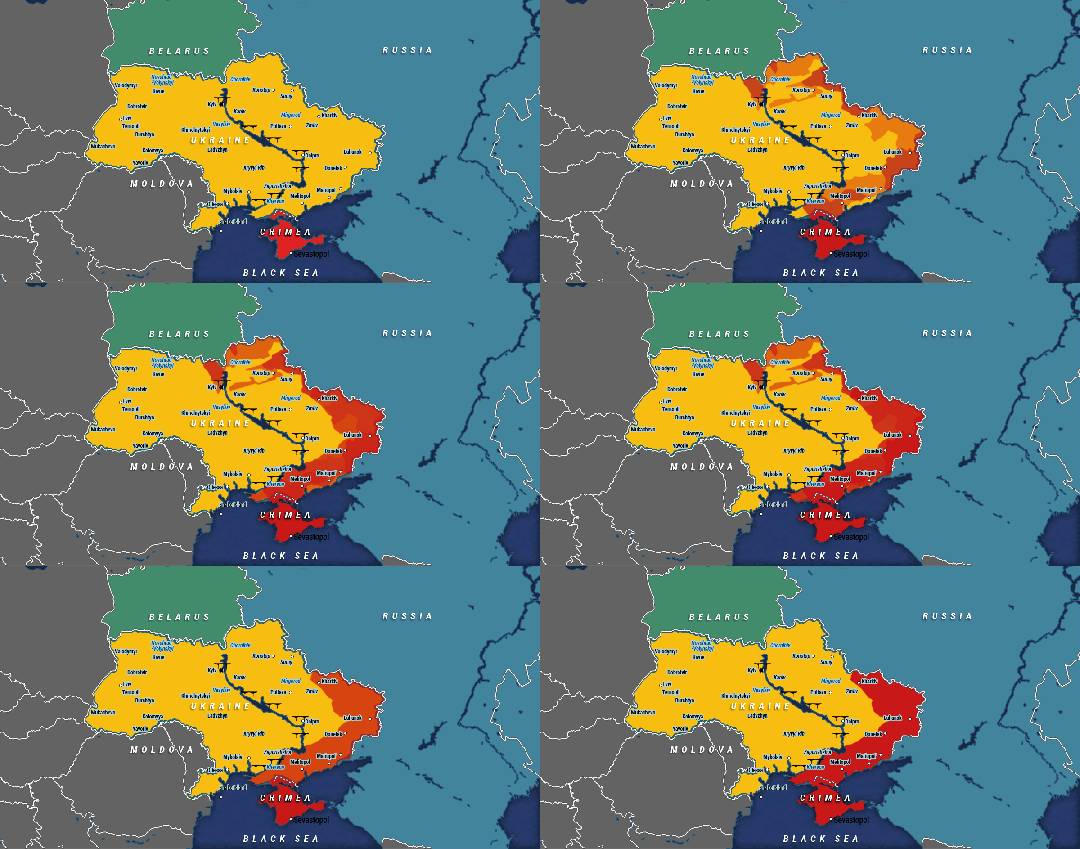
    Recent advances by Russian forces north and north-east of Kharkiv and intensified attacks along the eastern front are reminders that we must remain steadfast in supporting Ukraine.

    Russia’s recent territorial gains in Ukraine represent a significant threat to the stability and security of the European continent. The advances near Kharkiv and the intense fighting in the eastern regions highlight Moscow’s persistent ambition to extend its influence and control further into Europe. Allowing Russia to succeed would embolden other authoritarian regimes, undermine NATO’s collective security framework, and destabilize the broader region.

    The war in Ukraine is not just a regional conflict; it is a fundamental battle over the principles of national sovereignty and the rule of law.

    While other urgent and brutal conflicts and warfare around the world understandably capture public attention, we must not lose sight of the ongoing situation in Ukraine. Despite heavy losses, Ukrainian forces continue to hold critical positions, demonstrating the importance of sustained support.

    By supporting Ukraine, we defend the principles that underpin our global order and ensure that aggression and lawlessness do not prevail.

    The world must not turn away. It is imperative that we maintain our support and stand united against the forces of tyranny and oppression (wherever they are).

    At the same time, while we grapple with the grave allegations against Israel and the complex situation in Gaza, it is crucial to prioritise human lives first. Yes, of course, the international community must strive to support the Palestinian peoples’ self-determination and ensure that any violations of international law are met with consequences. However, our immediate priority must be the cessation of all warfare to prevent further loss of life.

    The tragic situations in Ukraine, Gaza, and other conflict zones demand urgent attention and resolution. Ending the bloodshed must come first, paving the way for peace and justice to follow.

  • Boosting Europe’s Industries

    Boosting Europe’s Industries

    Europe’s industrial landscape is still dynamic, diverse, and certainly globally interconnected. To maintain and enhance competitiveness, the European Union must adopt strategic measures that promote innovation, efficiency, and sustainability.

    We’ve got to invest in innovation

    The EU should double down on R&D spending. Encouraging both public and private investment in cutting-edge technologies to drive breakthroughs. We’ve also got to foster collaboration between businesses, academia, and research institutions. Joint efforts can lead to technological advancements that benefit all of us, not just our industries. But we’ve got to go beyond throwing money at it. We’ve got to actually implement these relationships.

    We’ve got to bring the price of energy down

    Reducing energy costs is critical for industrial competitiveness. Everyone tells us that. It’s common sense, we’ve got to do it. So we’ve got to diversisy energy sources, at scale, fast and slash prices in the process. Big ask, but we’ve got to deliver. Partners are playing at an advantage we don’t have, and we keep adding disadvantages for our own businesses.

    Get rid of unneeded bureaucracy

    We’ve got to streamline regulations to enhance business agility. The DP proposes a Commissioner with the specific agenda of bringing regulation into the 21st century. Easy to navigate, helping our business grow, instead of employing more people in compliance than the actual business itself. We’ve got to foster a supportive ecosystem for businesses to thrive.

    Europe’s commitment to the ecological transition and sustainability should align with its drive for economic growth and global competitiveness. Europe must strengthen its industries and remain a formidable player on the world stage. There’s a lot more work to be done, more than I’ve covered here. But I want you to know that’s on my mind, not just from a business perspective, from a strategic and geopolitical perspective too.

    We’ve got to work for Europe, all Europeans, in the interest not only of ourselves, but the entire world. An EU that thrives, can inspire and motivate the rest of the world.

  • Cybersecurity, a Secure and Resilient Europe

    Cybersecurity, a Secure and Resilient Europe

    In the upcoming EU elections, one of my primary concerns is the security and resilience of Europe in an increasingly digital and interconnected world.

    The concept of defense has evolved significantly in the 21st century. Traditional defense mechanisms, while still crucial, are no longer sufficient in isolation. Cyber threats targeting our critical infrastructure, financial systems, and even democratic processes are a challenge we have to keep on tackling. The European Union has got to make cybersecurity a key component of its defense strategy.

    From energy grids to communication networks, Europe’s infrastructure is increasingly reliant on digital technologies. A single cyberattack can disrupt entire cities, cause economic turmoil, and endanger lives. Recent incidents have shown how vulnerable our infrastructure can be, making it imperative to enhance our cyber defenses. Cybercrime, identity theft, and online fraud are growing concerns that affect millions of Europeans.

    A unified approach is essential. By fostering cooperation among member states, and sharing intelligence and best practices, we can create a resilient defense network capable of thwarting cyber threats.

    Cybersecurity is not just about defense of course; it’s also a driver of innovation. By investing in cybersecurity, Europe can lead in developing cutting-edge technologies and solutions that have global applications.

    As your candidate, I am committed to championing policies that strengthen our cybersecurity defenses and position Europe as a leader in the digital world.

  • All Eyes on Benjamin

    All Eyes on Benjamin

    “In the Bibi world there is no value, metric or significance for anything, other than pledging allegiance to the leader Benjamin Netanyahu each and every morning.” writes Chaim Levinson on Haaretz.

    Internal divisions in Israel are clearly apparent. Last Saturday night, extreme supporters of ‘Bibi’ attacked Gadi Kedem, a man who lost his family on October 7. “It’s a good thing they killed your children,” they cursed at his wife.

    Chaim goes on to write that this is ‘Israel’s second war of independence. It’s not against Hamas. It’s amongst ourselves.’

    It is what he says later that I find even more interesting: ‘Israel cannot afford not to be excellently managed. This place is violent and dangerous and rests on very delicate brakes and balances… Countries rise and fall. There were once empires, like Greece. They collapsed due to generation after generation of failed management.’

    It’s clear that most Israelis know that Netanyahu is not acting in the best interest of Israelis or Israel anymore. It’s been clear to many for a while, but now it must be really clear to most. Bibi only cares about Bibi and his view of what Israel must be. Even as world leaders try to warn him, he is responsible for the biggest loss of support Israel has seen in decades.

    Meanwhile, the world’s population has their eyes turned to Gaza, specifically Rafah. If my own social media were an indication of European sentiment, at least 1 in 3 people, or more, have their eyes on Rafah. “All Eyes on Rafah” is written on every second or third Instagram story, on Facebook, on Twitter, where people speak.

    Terrifying images coming out of camps after the recent bombing of Rafah, where people were living, thinking they were in a safe zone, have circulated to nearly every human being with a phone on Earth, or at least in the Western world.

    It’s a challenge to be vocal about how one feels, seeing the reality on the ground, without falsely insinuating that somehow, as a European Parliament candidate, you’d have any influence over Benjamin Netanyahu’s mind. And I’ve said it before, and I’ll say it again: most of us make it clear that we support all people’s right to self-determination, and we must ensure this is done, without professing, that the European Parliament has the direct ability to end or influence the immediate cessation of the ongoing violence.

    Israelis are scared, hoping to see friends and family return from tunnels in Gaza. Palestinians are scared, perhaps even hopeless, about the possibility of ever seeing loved ones again, unsure in the fog of war, in the dust, about whether they are separated forever or momentarily. The worst of our humanity has indeed been invoked, to paraphrase myself from October, and I’m unsure where this ends.

    From a national, Luxembourgish, perspective, it is clear that our government supports achieving a ceasefire. We do not engage in performance politics however. I believe other people’s plight should not become an electoral wager for politicians in third countries. Our priority must be to assist the people affected by this conflict and ensure the upholding of international law in Israel, Gaza, the West Bank, and the wider region.

    It is our collective responsibility to ensure we are capable of putting an end to the destruction of indescribable proportions taking place today, the upholding of international law, and to put ourselves in a position to support what comes next. From a European perspective too. But what will it take? I’ve said it again and again, if we are truly friends of Israel, we must help it from making the worst mistake it’s ever made. Benjamin Netanyahu, whether the latest strike was a mistake or not, should no longer feel capable of leading. Of course, we won’t wait for Netanyahu to find a moral center today. Has he ever had one? He won’t find it today.

    I am afraid, not only because we mourn thousands of our fellow human beings today. I am afraid for what this conflict is doing to our societies throughout Europe too. It’s pitting us against each other.

    Pretending like antisemitism is not on the rise is dangerous. Islamophobia and xenophobia are on the rise too. We’re being divided by our inability to help ensure peace at a time when Europe is not even certain of being able to guarantee its own peace. Maps are being redrawn, and what is happening is being used by various actors to advance their own expansion and agendas (see Erdogan).

    I can’t get the images of violence out of my head. But this is not about me, not about any of us typing statements from afar. I remember, was it a French journalist or an ex-politician who said, this is not the time for history lessons; this is not the time for context. Let this be done by historians. This is the time to guarantee peace and ceasefire so both Israelis and Palestinians can stop feeling fear and terror of each other and so that they can live in peace. Whatever needs to happen must happen now. Every now that’s past.

    My Jewish friends are scared, my Israeli friends are scared. My Muslim friends are in pain, my Palestinian friends are heartbroken. All of them, human beings, with hearts and fears, like you, like me. What I care about is how we build peace. And I’ve said it again and again, I know my scope and limitations. So what do we do? I ask you.

    We are setting up a generation that will hate each other. Once again, what can we learn from our own brutal history, the history of how most European countries chose to forgive aggressive countries from central Europe after World War II? How can we mend the wounds? Because if all we are setting up is a stage for perpetual fear of the other, revenge, and bloodshed, then nobody wins, nobody lives.

    All our eyes are on Netanyahu. He stands at a crossroads where his decisions will either further plunge the region into chaos or offer a slim chance for peace. It is not enough to merely critique his leadership and condemn the attack; the global community must take tangible steps to mediate, support, and pressure for a sustainable resolution.

    As we watch this tragedy unfold, we must remember that our collective humanity demands we strive for peace and justice for all.

  • Our fragile Union, a beacon of hope

    Our fragile Union, a beacon of hope

    Every bomb falling in Gaza, every rocket fired towards Tel Aviv, every shot fired in Donetsk, every bullet that kills in Kachin, in Darfur, in Las Anod or in any other ongoing conflict, is made by a human being. It’s an object made by a human being, used by a human being, to kill another human being. Every time a homophobic attack is committed, every time someones rapes, when a fight breaks out in a scho olyard, there’s a human being, inflicting terrible pain to another human being.

    Our world is by nature incredibly violent. It speaks to our collective evolution, that we have set up rules and laws, to help us participate safely and fairly in groups and society. It speaks to our better ambition, that we have set up institutions like the United Nations, to cooperate together at a global level. We have evolved to the point where we have even set universal human rights. Rights for all human beings, regardless of where they are born, where or when they live. But we are unfortunately still a long way to go, as a universal, or earthly society of human beings, from being able to argue and guarantee for all Humans’ human rights. We still have a lot of building to do, to ensure human rights are always upheld, and everywhere. As rights, not options. 

    As our world collectively and selectively forgets, and turns violent again, we find ourselves, in Europe, once again preparing for war. Preparing to have the ability to defend ourselves in case of conflict. To give us the best possible chances of avoiding conflict. Because as much as we have evolved, we still live in a world that is often divided, and where interests between groups are not always aligned. Within countries, and between countries. Even between and within alliances of countries. 

    I’m so incredibly passionate about our European Union because it is, fundamentally, a guarantor of peace and security. A group of countries, with incredibly diverse histories, different cultures, different languages, different DNA’s choosing to work together, instead of letting neither thousands of years of history, nor their more recent bloody history, divide them. Countries that were shaped by the history of others, and countries that shaped global history, countries that experienced rises and declines to their civilisations — choosing to work together, in the pursuit of compromise, peace and cooperation, over conflict and disagreement. In the pursuit of our better ambitions. As long as this ethos, and our influence, expands, we will hopefully be able to keep sending a message of peace and unity, and that we would rather see countries working together, than apart.

    Most of us, if not all of us, I hope, stand against every conflict, but I do not want to give you any illusions; none of us alone are capable of magically ending every conflict. In this Parliamentary Election, in Luxembourg, you get to pick 6 out of 720 Parliamentarians. We are all working, and giving it our all, to give you every reason, to help us strengthen the European Union, so that it is able to defend your rights, and privileges, and capable of influencing progress, peace and prosperity and uphold our agreed laws beyond our borders, from human rights, to the law of war and climate justice.

    We face great threats, within and outside our borders. From people who seek to take advantage of our disunity, external actors like other states and organizations, and internal actors, more interested in an illusion of developing themselves, than strengthening the whole. Our Union is fragile. And disunion would be catastrophic.

    The decision-maker, when it comes to how we will respond to all these challenges, and our ambitions for the future: that is each and every one of you, on the 9th of June. And in every election that comes after this, as long as we live in a democracy, and we are able to elect our leaders. I must have complete faith in all of you, to help us ensure, Europe remains a champion of hope, peace and justice. That Europe is empowered, so that we may continue to have a seat at the table of global negotiations.

    Our world is far from perfect. If it were, myself and many other young people wouldn’t be so incredibly passionate about contributing to our shared decision making. We are entering positions of responsibility, when and where you empower us, to shape a better world. In the process, all of us learn our scope, and limitations. And we learn to navigate, armed with our hopes and dreams, a system that feels old and outdated (both in decisions entrenched in itself, and in the way it operates); to make our contributions. Contributions that represent our generation, and our wants, our needs, our priorities. Whilst recognising that the entire system must run in parallel to this progress. Because, much like a Computer’s Operating System, our entire world depends on it. And in the future, a younger generation, armed with its own hopes and dreams, will attempt to do the same. Just as it’s happened before.

    The world did not begin when we were born, and probably not last Thursday, and it won’t end when we are gone. Some of us feel the need to take on more responsibility for the collective than others.

    I am a son of two people who grew up poor, the grandson of an orphan of war, a descendant of generations of enslaved people, and inside me the feeling of responsibility runs strong.

    Speaking for myself, I can only say that I know, in myself, that I am fighting for what I believe is right. That my conscience is clear, knowing full well, my intentions, which is to contribute, as little, or as much as I can to the world around me. To leave behind a world that’s a little bit better, a little bit more peaceful, a little bit more fair, and a little bit more sustainable. And I have, for years, made these intentions as transparent and available as possible.

    Most of my positions and ideas are available here on my website. 

    Specifically on what’s happening in Gaza, I’ve written again and again, perhaps more about it than any other subject, about the importance of humanity and international law prevailing. I’ve stitched together videos, to show what I listen to. And I shared it with you, for reasons of transparency. But as I’ve publicly said, I do not plan to campaign pretending like voting for me would magically end what’s happening. And I believe other people’s plight should not become an electoral wager for politicians in third countries. Our priority must be to assist people and ensure the upholding of international law, in Israel, in Gaza, in the West Bank, in the wider region, on the ground. It is our collectively responsibility to ensure we are capable of putting an end to the destruction of indescribable proportions taking place today, and to put ourselves in the position of supporting what comes next. My priority is to contribute to the resolution, to be able to be a voice of reason, when and where I can, knowing full well, once again, my limitations.

    Whether it’s in Gaza, in Ukraine or in Somalia. Whether it’s in China, in Mexico or Argentina. Whether someone is kept hostage, or killed without warning. Wherever human rights are violated, beyond empathy and shared pain, it threatens our civil liberties, as human beings, and we must always contest those who do not uphold the rule of law.

    Most things are difficult to build, hard to maintain, and easy to tear down.

    I am not looking to tear anything apart, I want us to continue building, ever-better, ever-together, ever-improving. It’s frustrating at times.. But that’s what it takes, to bring everyone on the same page, and build together.

    I hope you will all find it in yourselves, to help us collectively pave the way for a European Union that has a positive impact, for itself and the world.

    And one more thing

    I’m running an election that mathematically, I can’t win.

    Our candidacy is an underdog.

    I am running to represent you.

    To bring us closer together.

    If that doesn’t make my commitment to the very essence of our democracy clear…

    I don’t know what would.