Blog

  • Our fragile Union, a beacon of hope

    Our fragile Union, a beacon of hope

    Every bomb falling in Gaza, every rocket fired towards Tel Aviv, every shot fired in Donetsk, every bullet that kills in Kachin, in Darfur, in Las Anod or in any other ongoing conflict, is made by a human being. It’s an object made by a human being, used by a human being, to kill another human being. Every time a homophobic attack is committed, every time someones rapes, when a fight breaks out in a scho olyard, there’s a human being, inflicting terrible pain to another human being.

    Our world is by nature incredibly violent. It speaks to our collective evolution, that we have set up rules and laws, to help us participate safely and fairly in groups and society. It speaks to our better ambition, that we have set up institutions like the United Nations, to cooperate together at a global level. We have evolved to the point where we have even set universal human rights. Rights for all human beings, regardless of where they are born, where or when they live. But we are unfortunately still a long way to go, as a universal, or earthly society of human beings, from being able to argue and guarantee for all Humans’ human rights. We still have a lot of building to do, to ensure human rights are always upheld, and everywhere. As rights, not options. 

    As our world collectively and selectively forgets, and turns violent again, we find ourselves, in Europe, once again preparing for war. Preparing to have the ability to defend ourselves in case of conflict. To give us the best possible chances of avoiding conflict. Because as much as we have evolved, we still live in a world that is often divided, and where interests between groups are not always aligned. Within countries, and between countries. Even between and within alliances of countries. 

    I’m so incredibly passionate about our European Union because it is, fundamentally, a guarantor of peace and security. A group of countries, with incredibly diverse histories, different cultures, different languages, different DNA’s choosing to work together, instead of letting neither thousands of years of history, nor their more recent bloody history, divide them. Countries that were shaped by the history of others, and countries that shaped global history, countries that experienced rises and declines to their civilisations — choosing to work together, in the pursuit of compromise, peace and cooperation, over conflict and disagreement. In the pursuit of our better ambitions. As long as this ethos, and our influence, expands, we will hopefully be able to keep sending a message of peace and unity, and that we would rather see countries working together, than apart.

    Most of us, if not all of us, I hope, stand against every conflict, but I do not want to give you any illusions; none of us alone are capable of magically ending every conflict. In this Parliamentary Election, in Luxembourg, you get to pick 6 out of 720 Parliamentarians. We are all working, and giving it our all, to give you every reason, to help us strengthen the European Union, so that it is able to defend your rights, and privileges, and capable of influencing progress, peace and prosperity and uphold our agreed laws beyond our borders, from human rights, to the law of war and climate justice.

    We face great threats, within and outside our borders. From people who seek to take advantage of our disunity, external actors like other states and organizations, and internal actors, more interested in an illusion of developing themselves, than strengthening the whole. Our Union is fragile. And disunion would be catastrophic.

    The decision-maker, when it comes to how we will respond to all these challenges, and our ambitions for the future: that is each and every one of you, on the 9th of June. And in every election that comes after this, as long as we live in a democracy, and we are able to elect our leaders. I must have complete faith in all of you, to help us ensure, Europe remains a champion of hope, peace and justice. That Europe is empowered, so that we may continue to have a seat at the table of global negotiations.

    Our world is far from perfect. If it were, myself and many other young people wouldn’t be so incredibly passionate about contributing to our shared decision making. We are entering positions of responsibility, when and where you empower us, to shape a better world. In the process, all of us learn our scope, and limitations. And we learn to navigate, armed with our hopes and dreams, a system that feels old and outdated (both in decisions entrenched in itself, and in the way it operates); to make our contributions. Contributions that represent our generation, and our wants, our needs, our priorities. Whilst recognising that the entire system must run in parallel to this progress. Because, much like a Computer’s Operating System, our entire world depends on it. And in the future, a younger generation, armed with its own hopes and dreams, will attempt to do the same. Just as it’s happened before.

    The world did not begin when we were born, and probably not last Thursday, and it won’t end when we are gone. Some of us feel the need to take on more responsibility for the collective than others.

    I am a son of two people who grew up poor, the grandson of an orphan of war, a descendant of generations of enslaved people, and inside me the feeling of responsibility runs strong.

    Speaking for myself, I can only say that I know, in myself, that I am fighting for what I believe is right. That my conscience is clear, knowing full well, my intentions, which is to contribute, as little, or as much as I can to the world around me. To leave behind a world that’s a little bit better, a little bit more peaceful, a little bit more fair, and a little bit more sustainable. And I have, for years, made these intentions as transparent and available as possible.

    Most of my positions and ideas are available here on my website. 

    Specifically on what’s happening in Gaza, I’ve written again and again, perhaps more about it than any other subject, about the importance of humanity and international law prevailing. I’ve stitched together videos, to show what I listen to. And I shared it with you, for reasons of transparency. But as I’ve publicly said, I do not plan to campaign pretending like voting for me would magically end what’s happening. And I believe other people’s plight should not become an electoral wager for politicians in third countries. Our priority must be to assist people and ensure the upholding of international law, in Israel, in Gaza, in the West Bank, in the wider region, on the ground. It is our collectively responsibility to ensure we are capable of putting an end to the destruction of indescribable proportions taking place today, and to put ourselves in the position of supporting what comes next. My priority is to contribute to the resolution, to be able to be a voice of reason, when and where I can, knowing full well, once again, my limitations.

    Whether it’s in Gaza, in Ukraine or in Somalia. Whether it’s in China, in Mexico or Argentina. Whether someone is kept hostage, or killed without warning. Wherever human rights are violated, beyond empathy and shared pain, it threatens our civil liberties, as human beings, and we must always contest those who do not uphold the rule of law.

    Most things are difficult to build, hard to maintain, and easy to tear down.

    I am not looking to tear anything apart, I want us to continue building, ever-better, ever-together, ever-improving. It’s frustrating at times.. But that’s what it takes, to bring everyone on the same page, and build together.

    I hope you will all find it in yourselves, to help us collectively pave the way for a European Union that has a positive impact, for itself and the world.

    And one more thing

    I’m running an election that mathematically, I can’t win.

    Our candidacy is an underdog.

    I am running to represent you.

    To bring us closer together.

    If that doesn’t make my commitment to the very essence of our democracy clear…

    I don’t know what would.

  • Is it really Europe we’re talking about?

    Is it really Europe we’re talking about?

    Soundbites dominate discourse. National interests overshadow broader visions. We lose sight of the bigger picture. This is even more apparent in these European Parliament elections, where the ballot box may once again become a battleground for national grievances and triumphs rather than a platform for discussing and deciding the future of Europe as a whole.

    So, is it really Europe we’re talking about?

    In a European post-2004 era marked by unprecedented interconnectedness, where events in one corner of Europe and the globe can ripple across continents in seconds, the answer should be, a resounding yes. Whether it’s climate change, migration, or economic instability, the challenges facing Europe today transcend national borders. Ignoring this reality in favor of narrow, short-term interests is not only shortsighted but also perilous. Fragmented approaches, driven by individual national interests, will only serve to weaken our collective resilience. To confront the next stage of the global order effectively, we need a strong, cohesive EU capable of speaking with one voice on the world stage.

    It’s time to talk about Europe.

    This means recognizing that our fates are intertwined, and that only by working together can we navigate the challenges that lie ahead.

    It’s also about reclaiming our agency in shaping the world around us.

    We have a responsibility to engage in constructive dialogue, to seek common ground, and to advocate for policies that advance the greater good.

    This is not to say that national interests should be disregarded. On the contrary, they should be viewed through a European lens, mindful of their implications for the continent as a whole. By aligning our priorities and pooling our resources, we can amplify our impact and create a Europe that is not only stronger but also more resilient and prosperous.

    Are we willing to rise to the challenge of building a better Europe for future generations?

    The time for complacency is over. The time to talk about Europe is now.

  • A Vision for a Stronger and United Europe

    A Vision for a Stronger and United Europe

    Our Democratic Party (DP) election programme for the period 2024-2029.

    We outline a vision for a stronger and more united European Union. ​ In a time of social upheaval, a changing climate, and geopolitical risks, the DP emphasizes the need for collective action and a self-confident EU capable of addressing these challenges. ​Here’s a quick overview, and I encourage you to explore the full document for more details.

    Economic and Social Priorities ​

    • Building a competitive, resilient, and sustainable economy that creates jobs. ​
    • Strengthening the EU’s investment capacity to drive ecological and digital transitions. ​
    • Developing renewable energy sources and reducing dependence on fossil fuels. ​
    • Ensuring access to essential medicines and strategic reserves in Europe. ​
    • Promoting research and development to enhance competitiveness and tackle energy prices. ​
    • Investing in digitalization, cybersecurity, and defense capabilities.

    Effectively Combating Climate Change ​

    • Implementing the obligations of the Paris Climate Agreement and the commitments of the Green Deal. ​​
    • Urgently investing in renewable energies and expanding carbon sinks. ​
    • Promoting sustainable management of natural resources and circular economy practices. ​
    • Introducing reusable systems for packaging and combating programmed obsolescence. ​

    The Common Agricultural Policy ​​

    • Addressing the challenges faced by the agricultural sector, including price pressures and ecological transition. ​
    • Ensuring fair compensation for farmers affected by biodiversity protection measures. ​
    • Supporting scientific research to revitalize European agriculture. ​
    • Reforming the CAP to align with the Green Deal and improve implementation.

    Health

    • Prioritizing prevention and strengthening the EU’s capacity to respond to health crises. ​
    • Developing a decision-making capacity in the area of health and increasing production and storage of medical supplies. ​
    • Supporting medical research and utilizing digital data for innovative treatments.
    • Ensuring access to healthcare and protecting the rights of vulnerable groups.

    Strong Institutions for a High-Performance EU ​

    • Advocating for a Convention to revise the Treaties and improve the EU’s decision-making mechanisms. ​
    • Reforming the unanimity rule and enhancing qualified majority voting. ​
    • Strengthening the role of the European Parliament and promoting regular exchanges with citizens. ​
    • Defending Luxembourg’s role as the capital of Europe and ensuring smooth operation of EU institutions. ​

    Preparing the EU and Candidate Countries for Future Enlargements

    • Guaranteeing the maintenance of fundamental values and the ability to sanction violations.
    • Reforming the CAP and increasing the EU’s absorption capacity. ​
    • Welcoming new member states in stages based on their readiness and EU reform progress. ​
    • Strengthening European defense capabilities and promoting security cooperation. ​

    The EU’s Foreign Affairs and Defense Policy ​

    • Developing a coherent and effective foreign policy decision-making process. ​
    • Strengthening the EU’s voice in the world and promoting international cooperation. ​
    • Redefining relations with the African continent and supporting African representation in the UN Security Council. ​
    • Promoting cultural exchanges and defending artistic creation. ​

    New Migration Policy ​

    • Ensuring the right of asylum for those fleeing war, violations, and dictatorships. ​
    • Enhancing cooperation with countries of origin and transit and promoting humanitarian monitoring. ​
    • Strengthening solidarity and fair burden-sharing among member states. ​
    • Developing legal channels for skilled migration and addressing root causes of migration pressures.

    Rights and Values

    • Promoting gender equality, combating gender-based violence, and supporting LGBTQIA+ rights.
    • Protecting women’s reproductive rights and ensuring equal access to participation and decision-making. ​
    • Strengthening children’s rights and supporting education and cultural exchange programs.
    • Fighting discrimination and promoting social inclusion. ​

    Better Prospects for Young People​​

    • Supporting children’s rights, education, and vocational training.
    • Strengthening the Erasmus+ program and promoting youth entrepreneurship and innovation. ​
    • Addressing mental health challenges and combating drug use through balanced strategies.
    • Ensuring access to housing and promoting diverse housing typologies. ​

    Culture

    • Embracing cultural diversity, digital innovation, and sustainability. ​
    • Defending artistic creation and protecting cultural heritage.
    • Supporting cultural exchanges and promoting cultural diplomacy. ​
    • Strengthening the socio-economic impact of the cultural sector and protecting creators’ rights. ​

    Want to read the full document and explore the party’s detailed proposals for the future of Europe?

  • Coup d’état, April 21, 1967

    Coup d’état, April 21, 1967

    On this day, April 21, in 1967, Greece faced a pivotal moment in its history. Just a few days before the general election, Colonel George Papadopoulos orchestrated a coup d’état, ushering in a military regime that would endure for seven long years. My father at the time was 7 years old. The memories and testaments of people who lived through this period, my father, our friends, my grandparents, are a stark reminder of the fragility of democracy and the vital importance of preserving it.

    Democracy, with its core principles of freedom, equality, and participation, stands as a beacon of hope for societies worldwide. It guarantees the rights and liberties of individuals, fostering an environment where diverse voices can be heard and respected. However, democracy is not immune to threats, both from external forces and internal vulnerabilities.

    Living in a liberal society under stable governance is a privilege that should never be taken for granted. It provides the foundation for progress, prosperity, and peace. When democracy is undermined, it jeopardizes not only the rights and freedoms of citizens but also the stability and continuity of the social contract that binds society together.

    The aftermath of the coup in Greece serves as a poignant example of the consequences of political upheaval. Civil liberties were curtailed, dissent was suppressed, and the rule of law was undermined. The fabric of society was torn apart, leaving scars that would take years to heal.

    As we reflect on April 21, 1967, let us reaffirm our commitment to democracy and the values it represents. Let us recognize that the preservation of democracy requires constant vigilance and active participation from all members of society. By upholding the principles of democracy, we ensure a future where freedom, justice, and equality prevail for generations to come.

  • 30,605 EU Citizens will vote in Luxembourg for the future of Europe

    30,605 EU Citizens will vote in Luxembourg for the future of Europe

    I celebrate the surge in voter turnout among our non-Luxembourgish EU compatriots in the 2024 EU elections. This is not a statistical anomaly; it is a testament to the enduring spirit of democracy and the result of collective action!

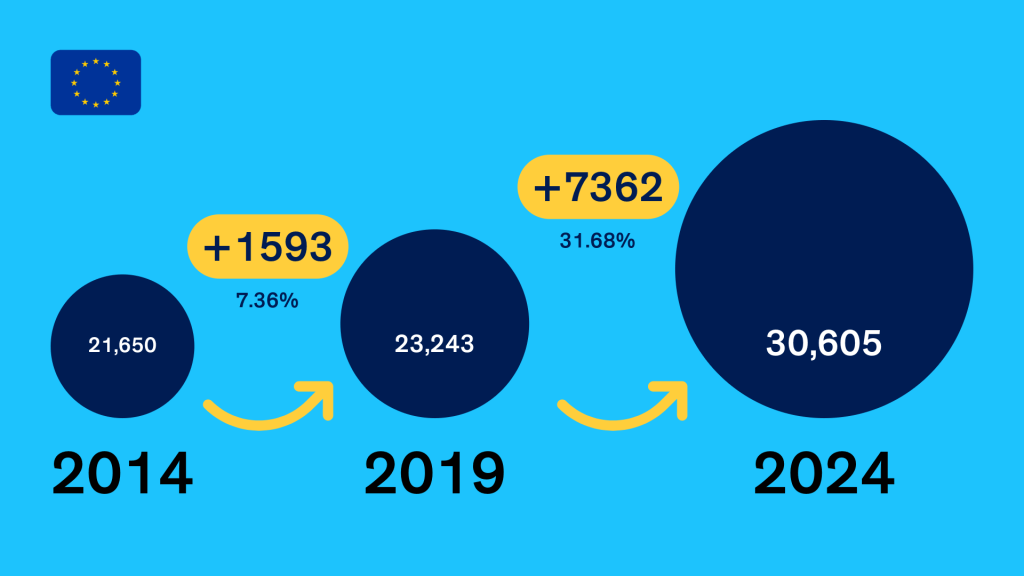
    A record-breaking 15.1% of non-Luxembourgish EU citizens have registered to cast their ballots here, in the country they call home, to shape the future of Europe, here, in Luxembourg.

    Behind this surge lies a tapestry of public and private multiplier efforts – a symphony of grassroots initiatives, advocacy campaigns, and community outreach programs aimed at amplifying the voices of the electorate.

    From neighborhood mobilization drives to digital and physical advocacy platforms, these initiatives have galvanized our compatriots, empowering them to wield their political voice and make them heard.

    Between 1994 and 1999, we witnessed an increase from 6,907 to 9,811 registered voters. From 9,811 in 1999 to 11,739 in 2004. The most substantial leap previously occurred between 2009 and 2014, as registrations surged from 17,579 to 21,650. From 2014 to 2019 registrations only rose from 21,650 to 23,243. Yet, between 2019 and 2024 we’ve got an unprecedented leap from 23,243 to 30,605 registrations, symbolizing a resounding affirmation of democratic values and the enduring spirit of civic engagement. (And not even counting the tens of thousands naturalised citizens!)

    Vive la participation, vive la democratie!

    Official Information: https://elections.public.lu/fr/actualites/2024/17-inscriptions-europennes.html

  • How the EU Can Help Young People Find a Home

    How the EU Can Help Young People Find a Home

    Let’s talk about housing. Not about soaring penthouses and bidding wars. Let’s talk about the kind young people across Europe are struggling to find: a decent, affordable place to call home.

    Now, housing policy is primarily a national competency. But here’s the thing: a generation stuck in cramped flatshares or priced out of the market altogether isn’t good for national economies, social mobility, or frankly, the future of Europe.

    The EU, as the champion of social progress and economic dynamism, can – and should – play a leading role. We’re not talking about a Housing Commissioner (though that’s a conversation for another day). We’re talking about smart policy frameworks that incentivize member states and empower young Europeans.

    Here’s a couple of ideas; and why I insisted on Housing being in our programme.

    1. Across the continent, red tape and permitting nightmares are strangling new construction. The EU can work with national governments to streamline approvals, especially for projects that prioritize affordability and diverse housing typologies. Think student dorms, co-operative housing models, and mixed-use developments that integrate housing with offices and green spaces.

    2. Financing a first home is a boulder on young shoulders. The EU can encourage national programs that offer loan guarantees, down payment assistance schemes, and tax breaks for first-time buyers. But let’s not forget developers. Here, the EU can create incentives for building diverse housing options, not just luxury condos.

    3. From Vienna’s renowned social housing program to innovative co-operative models in Germany, Europe has a wealth of successful housing policies. The EU can act as a platform for knowledge exchange, facilitating member states to learn from each other and adapt successful approaches to their specific contexts.

    4. The EU should continue to convene panels of architects, urban planners, mobility experts, and social scientists. To advise on best practices for sustainable, inclusive housing development that integrates seamlessly with transportation networks and public services. Their insights can inform national policy decisions and ensure we’re building not just homes, but livable, thriving communities.

    This isn’t about a one-size-fits-all solution. Each member state has its own unique housing challenges. But the EU can be the orchestra conductor, setting the tone and harmonizing national policies towards a shared goal: ensuring young Europeans have a secure and affordable place to build their lives.

    This isn’t just about bricks and mortar. It’s about a generation feeling empowered, rooted in their communities, and ready to contribute their full potential to a brighter European future. Let’s get building.