Category: Luxembourg

  • What next for Western Civilisation?

    What next for Western Civilisation?

    Hello,

    Our Western civilisation spans thousands of years, progress and conflict. If we want to retain any hope of navigating the challenges and opportunities ahead, we must be willing to understand our shared past.

    Our collective story is one of remarkable resilience and ingenuity. We are the bearers of a rich heritage of values and achievements. From the early agricultural societies and city-states of Ancient Greece to the Roman Empire and the transformative periods of the Renaissance, Enlightenment, and of course the Industrial Revolution, we have continuously reinvented ourselves.

    Today, our European Union and the United States represent the pinnacle of this long history of innovation, democracy, and social progress. Together, we embody the aspirations and achievements of countless generations. But what’s next?

    Today, I feel a deep sense of anxiety about our present and future. I’m alarmed by the many members of our societies that do not appreciate the profound historical context and the continuous struggle that has brought us to this point. The cyclical patterns of unity and disunity, progress and regress, are reminders of the fragility of our social fabric, but I refuse to believe decline is inevitable.

    Indeed, throughout history, periods of remarkable unity and progress have often been followed by phases of disunity and regression. The fall of the Roman Empire, the religious wars of the Reformation, the World Wars of the 20th century…

    Within nations, social progress and regress are intimately tied to the dynamics of income inequality. When wealth and opportunities are unevenly distributed, social tensions inevitably rise, leading to disunity and conflict. Par example, the Industrial Revolution brought unprecedented technological and economic advancements, but it also led to significant social strife due to the harsh working conditions and vast economic disparities it created. Similarly, today, growing income inequality threatens to undermine the social cohesion and stability of our societies.

    We must, at first those of us who seek to lead, and then those we must convince to let us guide, recognise, that our shared evolution has always been a balance between harnessing progress and managing its consequences, and of course that it includes dark pages too.

    Social justice, equity, and inclusivity are not just lofty ideals; they are essential components of a stable and prosperous society. Ensuring that the benefits of progress are widely shared is crucial to maintaining social harmony and preventing the cycles of disunity and conflict that have plagued us in the past.

    I firmly believe that we must lead with hope and determination.

    The European Union, as a project, though facing significant challenges, is a beacon of what can be achieved through unity and cooperation. The recent waves of nationalism and populism, which threaten to unravel the fabric of European unity, must serve as a warning.

    We must counter these trends with a renewed commitment to the principles of solidarity, inclusivity, and shared progress.

    Only through unity can we overcome the monumental challenges we face, from climate change and economic inequality to political instability and social injustice.

    The long-term survival of Western civilisation depends on our ability to learn from our shared past and apply those lessons to our present and future.

    If we truly hope, to, long-term, help achieve a planetary civilisation that honours our rich, diverse heritage and paves the way for generations to come, we’ve got to ensure we avoid decline now, protect our progress thus far, look at the big picture, and ensure we are capable of being part of the global stage in the future.

    Until next time,

    Christos FLOROS

  • Who wants to lead?

    Who wants to lead?

    Hello,

    The elections are over.

    But those of us who are engaged in politics know that elections are never over.

    That democracy is not a periodic appointment, but a constant, passionate, selfless and demanding engagement. Because democracy is simply the electoral system that allows participatory selection of leadership, but leadership is required throughout.

    I will continue to do my best, to contribute to our young country’s and our Union’s present and future, and to offer you reasons to participate and get engaged yourselves. My engagement did not begin a month ago, and will certainly not seize now.

    I’m grateful and thankful to all those who supported our effort, and I’m convinced that with your engagement, our generation will finally be able to take its future in its own hands.

    State of Affairs, Technology and Misinformation

    The situation in Europe worries me, and should worry us all. Whilst we enjoy some of the highest standards of living in the world, we have become complacent and susceptible to those who seek to divide us, and exploit our weaknesses.

    The extremes are polarising us, by amplifying our fears and using each other to drive us further apart. The moderate political centre, from socialists to conservatives, is being pulled further and further apart. Moderation, consensus, policies by and for all, are out — those who shout louder want increasingly, entirely different things.

    This is happening across Europe and across most Western liberal democracies. It’s not the first time our societies reach such a breaking point, however I still hope this time around we’ll be able to handle these situations more efficiently. After all, we’ve never had as much technology, never had the power to communicate as instantly, and never been as enabled to be informed and rally against a common cause (and unfortunately, empowered by the same technology to be misinformed and divided).

    Western leadership is dwindling, and that worries me for the world’s stability. Just look at who’s in Borgo Egnazia for the G7 today. Those who are dividing us internally, those politicians and the politics of division and finger pointing, those who claim to want to sustain every part of the system that supports us, whilst breaking and changing every part of it: they simply can’t. You can’t have your cake and eat it. Only moderates get that. And we’ve done a terrible job of communicating this.

    The Lack of Meaningful Debate

    Which brings me back to our elections. Where was the debate? Personally, if it weren’t for my own social media and online presence, which I maintained alone, I would have reached zero people. Unfortunately, I had zero media engagements. But even those who did. Was there debate? Was there real discussion about the big issues facing our continent today? Were there actual debates? I’d argue I only saw shows, but no debate. Talking points being communicated, but no exchange. And I refuse to believe that our public does not desire it. We saw very limited exchanges, heavily moderated exchanges. 

    Did we discuss the urgent questions surrounding our environmental impact on the world? Did we discuss any of the crucial debates happening worldwide around our access to resources? Specifically, plans to continue to press on with deep sea mining? Did we discuss the scopes and limitations of the European Union vis a vis our engagement and influence in Israel and Gaza, in Ukraine, in Russia, in China and Taiwan, in Africa? Did we discuss immigration beyond the talking points presented by political parties (with facts and expertise?); did we discuss the resurgence of religious political influence throughout Europe? Did we discuss voting participation in Luxembourg, and what it means that so many of our EU compatriots chose to vote in Luxembourg? And how about showing an interest in all candidates? Political parties do not define us, nor do they define our ideas; it is we, the party members, who define our parties — and by not allowing all of us some minimum visibility, you are not accurately representing either the process, ourselves, or the public’s options. I was asked not to criticise the press during the campaign, but I hope this is seen at least now, not as negative criticism, but positive feedback and criticism to improve. Because we desperately need the press today, we desperately need the media to contribute to our democracy.

    “My advice to the press is to remember that you’re an important part of government and democracy, and act like it.” Howard Dean, former governor of Vermont

    “The backbone of any democracy is an independent, professional and responsible media. Their role is to inform, criticise and stimulate debate.” Peter Joseph Millett CMG, British Diplomat

    “The media today is driven by numbers. If you get a congressman idiotic enough to take pictures of himself and tweet them out, that gets 600 times more coverage than the dangers of an Iranian nuclear weapon.” Newt Gingrich, former speaker of the House (USA)

    If we want to restore our ability to decide together, based evidence and not ideology, if we want to enable ourselves to live and co-exist and decide together, we need to enable an environment that rewards stepping up to offer yourself for leadership, an environment where ideas and exchange of facts and perspectives is not only permitted, certainly not thwarted, but supported. We need the press to step up, and play a role in mediating and flourishing our democratic debate, or it will be entirely ignored, for the much more efficient, direct, and entire uncensored social media, where extremist, flashy, unfounded claims attract, maintain, and grow the voting base of those who offer very little substance, but a very good show.

    The world needs leadership, Europe needs leadership, Luxembourg needs leadership — and we need my generation, your generation, the generation after us, to be inspired and convinced, that the herculean task of putting yourself up for public leadership positions, is worthwhile and not simply toxic and thankless (even if it’s certainly the latter).

    (By the way, if some of you are thinking of our climate and ability to protect our natural habitat while reading this, well done! Without clear leadership, we will be en route to destroy the very ecosystem that sustains all of us)

    I sincerely hope that over the next 5 years, I can convince more of you to get involved, and get engaged in our shared decision making.

    Who wants to lead?

    The fight for our democracies must continue, with you.

    We’re just beginning.

    Christos FLOROS

    My ancestors called themselves Roman. I call myself European. How long will we last? It’s up to us.

  • Every Nation for Itself

    Every Nation for Itself

    This is not just a ‘thank you’ post.

    But first, yes:

    28,874 personal thank you‘s for supporting me.

    And 253,344 thank you‘s for supporting our incredible DP – Demokratesch Partei team.

    To have earned your trust, your support, your faith, in my, and our team’s ability to deliver for you, that requires a huge, and sincere, thank you.

    My projections for Luxembourg and Europe were unfortunately accurate, and yet on an emotional level, we always hope to do better.

    One always hopes to do better than their own data indicates. Even if, again, I have to thank you, for giving me almost double the personal support I expected in my first election, especially one that I fought without any press, or media coverage — entirely with you, entirely grassroots. But this is not about any one person, or even any one country. Because these were European elections, about the future of our Union.

    So, let’s make it clear:

    The extremes did not win these elections, but many of us around Europe lost them. By failing (over the years, not just in this campaign) to convince our fellow citizens, that we can do better. And we must listen very clearly to this democratic protest.

    The biggest loser of these Elections is the European Union.

    ‘Divide et impera’: we are being divided, and the fact that many of us seem to ignore a carefully curated plan being actioned, is incredibly worrying.

    Those who seek to divide us have infiltrated our society, our media, our industries, our public discourse, and our politics.

    And the trend is clear, our Union is polarised, both in terms of political direction and in terms of supranational unity.

    Those of us who are responsible, moderate, politicians must be willing to take responsibility for this loss of confidence in our Union.

    Those of us who have opened a history book more than twice in our lives, must be willing to continue working, just as passionately, just as determined, to ensure history does not repeat itself.

    We must be willing to continue doing everything we can, to ensure Europe delivers for its citizens.

    Because we have got to take responsibility for the results all over Europe.

    Even if my generation is only just entering politics, we must be willing to take responsibility for the previous generations too. Because that’s what leaders do.

    European citizens are tired of overregulation. European citizens are fed-up with a European Union unable to work successfully together on border control. European citizens are frustrated, that we keep asking more of them, than we are able to offer them. European citizens are tired of handouts, when the majority of them work incredibly hard for their dues. European citizens want to be empowered to succeed.

    In the process of this protest, in the process of this polarisation, we are having our Trump moment. Mirroring what is happening in the United States, as I told Christelle BRUCKER yesterday. The big difference however is this: Trump loves Trump. And in Europe we don’t actually elect a single Trump. We elect multiple different Trumps, who each only love themselves, and their nations. A Europe of nations, working in their own self-interest, in a G-Zero world (yes, I’ve stolen the title from Ian Bremmer‘s 2012 book) will not deliver for any European citizen, regardless of how industrious, capable or ambitious the individual nation may be.

    Our countries, may have bright histories, but only together, do we pull enough weight in the world today (and even together, we’ve been reducing our weight enormously over the years – see image below). The United States are innovating, and we are simply falling behind, as China rises at an incredible pace.

    Only a strong, empowered, and purpose-led European Union can deliver for European citizens. Whether Spanish, French, Greek or Luxembourgish. Whether Romanian, Portuguese, German or Finnish.

    Share of World GDP / observations in text above

    So bottom line, here’s what I am going to do.

    • I will continue to be incredibly active in my country’s politics, at every level, micro-local, local, national and international.
    • I will continue investing my time and energy for you, within the DP – Demokratesch Partei to ensure we can conserve our Union and ensure we collectively succeed in the new global order.
    • I will continue attempting to make our politics more accessible, and more open to both criticism and participation.
    • I will continue encouraging, with my incredible colleague Jana Degrott (who by the way, not only had an incredible score, but also proved to be one of our country’s most committed politicians) more people to get involved.
    • I will continue speaking about AI, Defence and Cybersecurity (including Misinformation and Foreign Influence).
    • I will continue speaking about Europe’s competitiveness, our economy, our industries.
    • I will continue to ask for increased availability of information across our media in Luxembourg.

    And you may have guessed it:

    I will continue asking more of you, to choose to take responsibility and REGISTER TO VOTE.

    I want to thank all of you again for your support,

    Thank Charles Goerens , Amela Skenderovic , Nancy Braun , Jana Degrott , Gusty Graas and the entire team, every section, every MP, every member, every volunteer, for their support, and engagement into our campaign, to strengthen Europe.

    I want to also thank you for reading,

    I believe in Europe.

    If every nation in our Union plays for itself, we will all lose in the new state of the world.

    If we can continue to play together, with real, purposeful leadership, then we can succeed.

    Thank you for everything,

    This was the hardest thing I’ve ever done, and I look forward to doing it again for you, for our city, our country, our Union, and yes, the collective success of our world.

    Kind regards,

    Christos FLOROS

  • Have we forgotten Ukraine?

    Have we forgotten Ukraine?

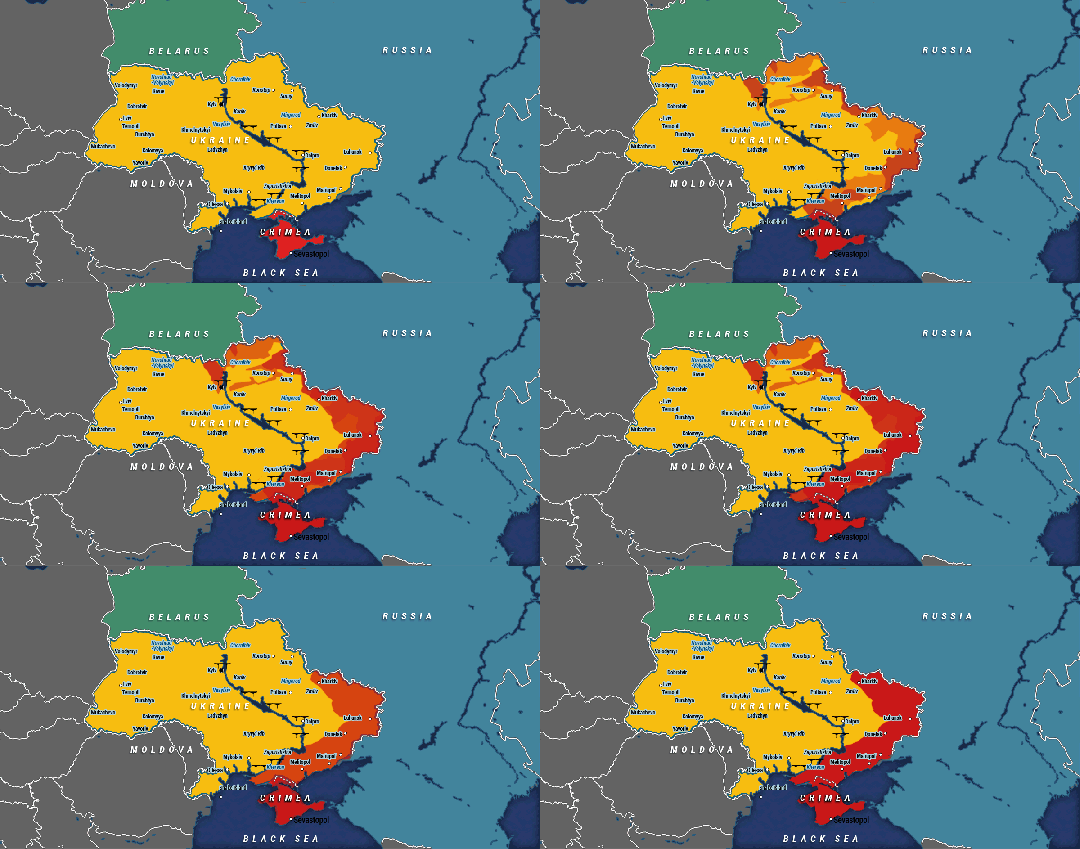
    Recent advances by Russian forces north and north-east of Kharkiv and intensified attacks along the eastern front are reminders that we must remain steadfast in supporting Ukraine.

    Russia’s recent territorial gains in Ukraine represent a significant threat to the stability and security of the European continent. The advances near Kharkiv and the intense fighting in the eastern regions highlight Moscow’s persistent ambition to extend its influence and control further into Europe. Allowing Russia to succeed would embolden other authoritarian regimes, undermine NATO’s collective security framework, and destabilize the broader region.

    The war in Ukraine is not just a regional conflict; it is a fundamental battle over the principles of national sovereignty and the rule of law.

    While other urgent and brutal conflicts and warfare around the world understandably capture public attention, we must not lose sight of the ongoing situation in Ukraine. Despite heavy losses, Ukrainian forces continue to hold critical positions, demonstrating the importance of sustained support.

    By supporting Ukraine, we defend the principles that underpin our global order and ensure that aggression and lawlessness do not prevail.

    The world must not turn away. It is imperative that we maintain our support and stand united against the forces of tyranny and oppression (wherever they are).

    At the same time, while we grapple with the grave allegations against Israel and the complex situation in Gaza, it is crucial to prioritise human lives first. Yes, of course, the international community must strive to support the Palestinian peoples’ self-determination and ensure that any violations of international law are met with consequences. However, our immediate priority must be the cessation of all warfare to prevent further loss of life.

    The tragic situations in Ukraine, Gaza, and other conflict zones demand urgent attention and resolution. Ending the bloodshed must come first, paving the way for peace and justice to follow.

  • Our fragile Union, a beacon of hope

    Our fragile Union, a beacon of hope

    Every bomb falling in Gaza, every rocket fired towards Tel Aviv, every shot fired in Donetsk, every bullet that kills in Kachin, in Darfur, in Las Anod or in any other ongoing conflict, is made by a human being. It’s an object made by a human being, used by a human being, to kill another human being. Every time a homophobic attack is committed, every time someones rapes, when a fight breaks out in a scho olyard, there’s a human being, inflicting terrible pain to another human being.

    Our world is by nature incredibly violent. It speaks to our collective evolution, that we have set up rules and laws, to help us participate safely and fairly in groups and society. It speaks to our better ambition, that we have set up institutions like the United Nations, to cooperate together at a global level. We have evolved to the point where we have even set universal human rights. Rights for all human beings, regardless of where they are born, where or when they live. But we are unfortunately still a long way to go, as a universal, or earthly society of human beings, from being able to argue and guarantee for all Humans’ human rights. We still have a lot of building to do, to ensure human rights are always upheld, and everywhere. As rights, not options. 

    As our world collectively and selectively forgets, and turns violent again, we find ourselves, in Europe, once again preparing for war. Preparing to have the ability to defend ourselves in case of conflict. To give us the best possible chances of avoiding conflict. Because as much as we have evolved, we still live in a world that is often divided, and where interests between groups are not always aligned. Within countries, and between countries. Even between and within alliances of countries. 

    I’m so incredibly passionate about our European Union because it is, fundamentally, a guarantor of peace and security. A group of countries, with incredibly diverse histories, different cultures, different languages, different DNA’s choosing to work together, instead of letting neither thousands of years of history, nor their more recent bloody history, divide them. Countries that were shaped by the history of others, and countries that shaped global history, countries that experienced rises and declines to their civilisations — choosing to work together, in the pursuit of compromise, peace and cooperation, over conflict and disagreement. In the pursuit of our better ambitions. As long as this ethos, and our influence, expands, we will hopefully be able to keep sending a message of peace and unity, and that we would rather see countries working together, than apart.

    Most of us, if not all of us, I hope, stand against every conflict, but I do not want to give you any illusions; none of us alone are capable of magically ending every conflict. In this Parliamentary Election, in Luxembourg, you get to pick 6 out of 720 Parliamentarians. We are all working, and giving it our all, to give you every reason, to help us strengthen the European Union, so that it is able to defend your rights, and privileges, and capable of influencing progress, peace and prosperity and uphold our agreed laws beyond our borders, from human rights, to the law of war and climate justice.

    We face great threats, within and outside our borders. From people who seek to take advantage of our disunity, external actors like other states and organizations, and internal actors, more interested in an illusion of developing themselves, than strengthening the whole. Our Union is fragile. And disunion would be catastrophic.

    The decision-maker, when it comes to how we will respond to all these challenges, and our ambitions for the future: that is each and every one of you, on the 9th of June. And in every election that comes after this, as long as we live in a democracy, and we are able to elect our leaders. I must have complete faith in all of you, to help us ensure, Europe remains a champion of hope, peace and justice. That Europe is empowered, so that we may continue to have a seat at the table of global negotiations.

    Our world is far from perfect. If it were, myself and many other young people wouldn’t be so incredibly passionate about contributing to our shared decision making. We are entering positions of responsibility, when and where you empower us, to shape a better world. In the process, all of us learn our scope, and limitations. And we learn to navigate, armed with our hopes and dreams, a system that feels old and outdated (both in decisions entrenched in itself, and in the way it operates); to make our contributions. Contributions that represent our generation, and our wants, our needs, our priorities. Whilst recognising that the entire system must run in parallel to this progress. Because, much like a Computer’s Operating System, our entire world depends on it. And in the future, a younger generation, armed with its own hopes and dreams, will attempt to do the same. Just as it’s happened before.

    The world did not begin when we were born, and probably not last Thursday, and it won’t end when we are gone. Some of us feel the need to take on more responsibility for the collective than others.

    I am a son of two people who grew up poor, the grandson of an orphan of war, a descendant of generations of enslaved people, and inside me the feeling of responsibility runs strong.

    Speaking for myself, I can only say that I know, in myself, that I am fighting for what I believe is right. That my conscience is clear, knowing full well, my intentions, which is to contribute, as little, or as much as I can to the world around me. To leave behind a world that’s a little bit better, a little bit more peaceful, a little bit more fair, and a little bit more sustainable. And I have, for years, made these intentions as transparent and available as possible.

    Most of my positions and ideas are available here on my website. 

    Specifically on what’s happening in Gaza, I’ve written again and again, perhaps more about it than any other subject, about the importance of humanity and international law prevailing. I’ve stitched together videos, to show what I listen to. And I shared it with you, for reasons of transparency. But as I’ve publicly said, I do not plan to campaign pretending like voting for me would magically end what’s happening. And I believe other people’s plight should not become an electoral wager for politicians in third countries. Our priority must be to assist people and ensure the upholding of international law, in Israel, in Gaza, in the West Bank, in the wider region, on the ground. It is our collectively responsibility to ensure we are capable of putting an end to the destruction of indescribable proportions taking place today, and to put ourselves in the position of supporting what comes next. My priority is to contribute to the resolution, to be able to be a voice of reason, when and where I can, knowing full well, once again, my limitations.

    Whether it’s in Gaza, in Ukraine or in Somalia. Whether it’s in China, in Mexico or Argentina. Whether someone is kept hostage, or killed without warning. Wherever human rights are violated, beyond empathy and shared pain, it threatens our civil liberties, as human beings, and we must always contest those who do not uphold the rule of law.

    Most things are difficult to build, hard to maintain, and easy to tear down.

    I am not looking to tear anything apart, I want us to continue building, ever-better, ever-together, ever-improving. It’s frustrating at times.. But that’s what it takes, to bring everyone on the same page, and build together.

    I hope you will all find it in yourselves, to help us collectively pave the way for a European Union that has a positive impact, for itself and the world.

    And one more thing

    I’m running an election that mathematically, I can’t win.

    Our candidacy is an underdog.

    I am running to represent you.

    To bring us closer together.

    If that doesn’t make my commitment to the very essence of our democracy clear…

    I don’t know what would.

  • Is it really Europe we’re talking about?

    Is it really Europe we’re talking about?

    Soundbites dominate discourse. National interests overshadow broader visions. We lose sight of the bigger picture. This is even more apparent in these European Parliament elections, where the ballot box may once again become a battleground for national grievances and triumphs rather than a platform for discussing and deciding the future of Europe as a whole.

    So, is it really Europe we’re talking about?

    In a European post-2004 era marked by unprecedented interconnectedness, where events in one corner of Europe and the globe can ripple across continents in seconds, the answer should be, a resounding yes. Whether it’s climate change, migration, or economic instability, the challenges facing Europe today transcend national borders. Ignoring this reality in favor of narrow, short-term interests is not only shortsighted but also perilous. Fragmented approaches, driven by individual national interests, will only serve to weaken our collective resilience. To confront the next stage of the global order effectively, we need a strong, cohesive EU capable of speaking with one voice on the world stage.

    It’s time to talk about Europe.

    This means recognizing that our fates are intertwined, and that only by working together can we navigate the challenges that lie ahead.

    It’s also about reclaiming our agency in shaping the world around us.

    We have a responsibility to engage in constructive dialogue, to seek common ground, and to advocate for policies that advance the greater good.

    This is not to say that national interests should be disregarded. On the contrary, they should be viewed through a European lens, mindful of their implications for the continent as a whole. By aligning our priorities and pooling our resources, we can amplify our impact and create a Europe that is not only stronger but also more resilient and prosperous.

    Are we willing to rise to the challenge of building a better Europe for future generations?

    The time for complacency is over. The time to talk about Europe is now.