Tag: Luxembourg City

  • Luxembourg’s Old-Age Dependency Ratio

    Luxembourg’s Old-Age Dependency Ratio

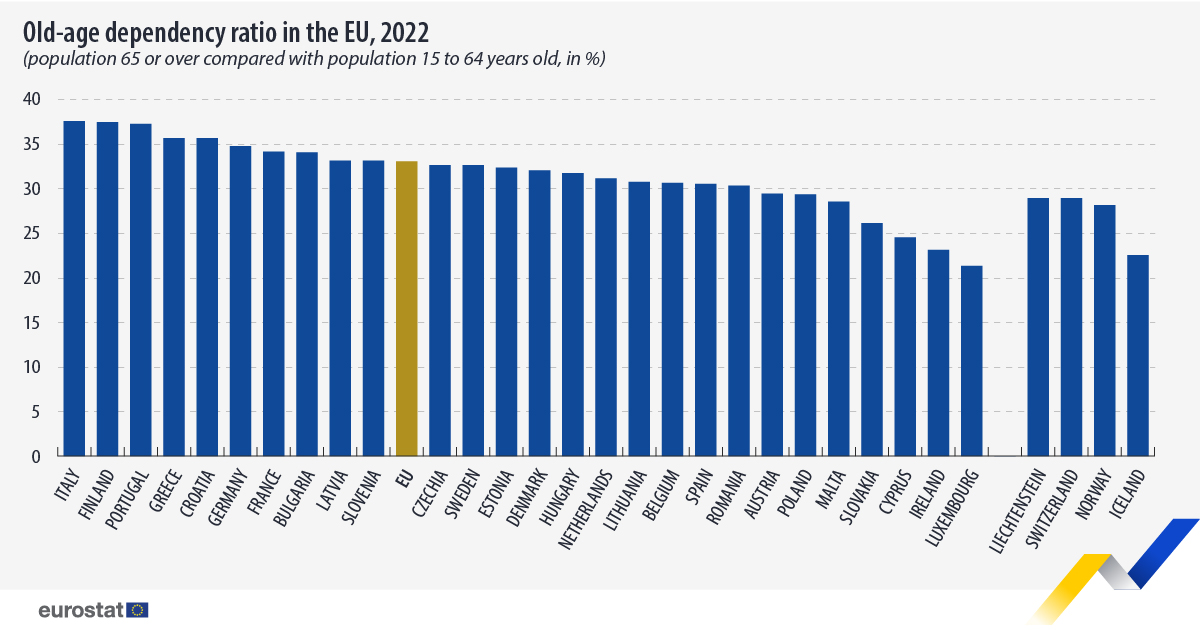
    Luxembourg, is modestly redefining the demographic narrative within the EU. The reason is clear and precise: its old-age dependency ratio is the envy of our neighbors, and it all boils down to a strategic influx of a young, tax-paying, (and mostly European) workforce.

    This isn’t a stroke of luck; it’s policy at its most pragmatic. Luxembourg has cracked the code by actively courting a diverse pool of skilled workers, predominantly from within Europe. Unlike many EU nations grappling with an aging population, Luxembourg has managed to sustain a robust balance between its elderly and working-age citizens.

    The secret lies in the numbers: a workforce that not only contributes to the nation’s economic prosperity but also ensures a manageable burden on its social support systems. In Luxembourg, the elderly aren’t an impending crisis; they’re a population well-supported by the vibrant and tax-generating younger demographic.

    As we gear up for the EU elections in June 2024, Luxembourg’s success story holds crucial lessons. It’s not just about economic growth; it’s about ensuring that the backbone of this success, the young and tax-paying workforce, actively participates in shaping the future of the European Union.

    The call to action is clear: this demographic segment, largely responsible for Luxembourg’s enviable old-age dependency ratio, must not be sidelined in the democratic process. Their voices, their concerns, and their votes need to reverberate in the upcoming elections. The very demographic that has propelled Luxembourg to its unique position is the key to navigating the challenges of an aging population across the EU.

    Ahead of June 2024, register to vote for the European elections in Luxembourg on June 9, and then as we step into the polling booths, let’s not forget the lesson from our country: a thriving, engaged, and diverse workforce is not just an economic asset; it’s the linchpin of a sustainable demographic future for the European Union.

  • A New Era for Politics: Starting from the Grassroots

    A New Era for Politics: Starting from the Grassroots

    Society should never be taken for granted. Across Europe, citizens are growing increasingly discontented, rejecting passivity, and demanding more from their leaders.

    The time has come for a transformation in European politics, one that begins at the grassroots level. The traditional “funnel” approach of party politics, which often rewards long-time members while neglecting society, needs a profound overhaul. This need for change is not unique to any one country; even in Luxembourg, similar concerns resonate.

    Arrogance in politics has become a significant concern for the public. Politicians who fail to listen to their constituents and prioritize their own egos over the needs of the people are being met with growing resistance. The electorate is no longer willing to tolerate the politics-as-usual approach that often reeked of complacency and entitlement.

    A notable shift is underway in the realm of European politics. The old routine has been disrupted over the past decade, signaling a need for new inspiration. Citizens are growing more engaged and interested in politics, seeking genuine change and accountability from their leaders. This surge in political interest is a reflection of society’s evolving values and expectations.

    To bridge the growing gap between traditional party politics and the changing society they aim to serve, a fundamental shift is necessary. Parties must adapt to these new realities and create an inclusive political environment. The parties themselves must become platforms for fresh voices and ideas.

    European politics, starting at the grassroots level, must embrace change. Parties need to facilitate increased citizen participation and actively seek out diverse perspectives. Society should never be taken for granted, and the political landscape must evolve to reflect the aspirations and demands of the people.

    In Luxembourg, as in other European nations, the call for change is echoing louder with each election. The time has come for a politics that is more responsive, inclusive, and humble. To restore trust and relevance in the eyes of the public, parties must adapt and recognize that the real power lies with the people.

    A new era of European politics is on the horizon, and it begins with a change in mindset at the grassroots level.

  • AI: Augmenting our Potential, Not Replacing It

    AI: Augmenting our Potential, Not Replacing It

    The AI revolution is well underway, with the technology demonstrating unprecedented abilities in areas such as natural language processing, image recognition, and complex problem-solving (Hi Talkwalker!). Yet, the essence of this revolution goes beyond just the technology itself; it lies in the profound changes AI can bring to human society and the workforce.

    The fear that AI will replace humans in the workplace is a narrative that often takes center stage. However, it’s imperative that we shift our perspective. Instead of viewing AI as a threat, we should embrace it as a tool for augmenting our capabilities.

    • AI can complement human creativity. It can analyze data, recognize patterns, and generate novel ideas. This collaboration between humans and AI can result in more imaginative solutions to complex problems.
    • AI can handle repetitive, data-intensive tasks with speed and precision, freeing humans to focus on more value-added work. This leads to increased efficiency and productivity.
    • In education, AI can tailor learning experiences to individual students, adapting to their pace and preferences. It empowers educators with data-driven insights to enhance teaching methodologies.
    • AI in healthcare assists doctors in diagnosing diseases more accurately and personalizing treatment plans. It ensures that patients receive the best care possible.
    • AI plays a vital role in monitoring and optimizing resource use, reducing waste, and mitigating environmental issues. By collaborating with AI, we can address global challenges more effectively.

    AI is not the harbinger of a jobless future; it’s an opportunity to redefine how we work, learn, and create. The collaborative potential of humans and AI is what sets this revolution apart. It’s a partnership where the strengths of each entity amplify the other’s capabilities.

    With this newfound potential, it’s vital to address the ethical dimensions of AI. Transparency, fairness, and accountability should guide the development and deployment of AI systems. We must ensure that AI technologies do not perpetuate biases or threaten individual freedoms.

    As AI becomes more integrated into our lives, there’s an urgent need for education and upskilling. By embracing AI as an augmentation tool, we open the door to exciting new career opportunities and encourage a continuous learning mindset.

    AI is not here to replace us; it’s here to help us reach new heights, solve complex challenges, and enhance our quality of life. By embracing AI as a partner in our journey, we unlock unprecedented opportunities that will shape the future of our society and the world at large.

  • Why We Should Care About the European Elections

    Why We Should Care About the European Elections

    The European Parliament and the Need for Renewal

    In the labyrinth of European politics, Luxembourg, and its role in the European Union (EU) is anything but minor. It’s here, in the European Parliament, that Luxembourg’s influence and the quality of its representation truly matter, especially during these tumultuous times.

    The European Parliament may not have the immediate glamour of, say, the European Commission, but it’s the beating heart of the EU’s democratic soul. While the European Commission might be the executive branch of the EU, the Parliament is where the people’s voices come to life. Every five years, during the European elections, citizens across the EU cast their votes to elect Members of the European Parliament (MEPs), and Luxembourg dispatches six MEPs to join the assembly.

    The European Parliament carries a trifecta of crucial roles: legislation, oversight, and representation. It is the keystone of the EU’s decision-making, contributing to legislation that can affect the lives of millions, overseeing the activities of other EU institutions, and representing the myriad voices that echo within the EU’s diverse boundaries.

    Luxembourg’s role in the EU is not just symbolic; it’s pivotal. The policies and regulations devised within the hallowed halls of the European Parliament cast long shadows on our everyday lives. Whether it’s trade, environmental protections, workers’ rights, or consumer safeguards, the Parliament has a direct hand in crafting the rules that shape our existence. For Luxembourg, whose economic well-being is closely entwined with international trade and finance, decisions concerning the single market, financial regulations, and cross-border transactions are of existential importance.

    Moreover, the Parliament steers the course on environmental and climate policies, a topic that reverberates deeply within Luxembourg, as we are a country committed to sustainability and a key player in the EU’s climate ambitions. The European Parliament basically wields a substantial influence on the issues that matter most to us.

    Luxembourg, harbors an unshakeable allegiance to the European project. This allegiance goes beyond the economic calculus; it’s rooted in the belief that unity, cooperation, and shared values are the bedrock of European integration. Amidst the cacophony of nationalistic fervor that’s swept the continent, Luxembourg serves as a stalwart advocate for further European integration.

    Our multicultural country with its multilingual reality epitomises the diversity and openness the EU stands for. It’s a symbol of unity and cooperation, where different cultures and languages harmoniously coexist. This very spirit is what the EU was designed to foster, and Luxembourg is living proof of its success.

    Next year, I hope with more EU residents than ever before registering to vote, we can begin to represent this success and reality at the Parliament. In these turbulent times for Europe, where geopolitical storms, economic uncertainties, migration, and climate change loom large, Luxembourg’s role in the European Parliament becomes all the more critical. It’s imperative that we send representatives who are not only competent but also ardently committed to the cause of a united Europe.

    We must be champions of dialogue, master negotiators, and adept at building alliances to resolve the pressing issues that affect all of us. Navigating the labyrinth of EU decision-making is an art, and our MEPs must be the maestros.

    But it doesn’t stop at competence. Our representatives should harbor an unyielding passion for addressing Luxembourg’s unique challenges. With its compact size and prominence as a financial hub, Luxembourg needs MEPs who can passionately advocate for our specific interests while aligning with the broader European vision.

    Luxembourg’s voice may be modest in volume, but it should resonate with resounding expertise and conviction within the European Parliament both in Strasbourg, and Brussels.

  • The Imperative of Inclusion, Representation, and Unity in Luxembourg

    The Imperative of Inclusion, Representation, and Unity in Luxembourg

    Luxembourg is known for its remarkable economic prosperity, strong political stability, and a diverse and vibrant society. However, like any country, it faces its own set of challenges, including issues related to housing and hidden debt.

    In this short post I want us to explore the critical importance of inclusion, representation, and unity in Luxembourg, not only for political stability but also for addressing these pressing challenges.

    And that’s why we must also call upon our politicians to take responsibility for fostering inclusivity and diversity in leadership to build a brighter future for our nation.

    The Strength of Diversity

    Luxembourg is a mosaic of cultures, languages, and backgrounds. Our society thrives on diversity, and it is a source of strength. Embracing this diversity helps us tap into the rich tapestry of experiences and ideas that make us unique, in the most interesting of ways. It is not just a matter of acknowledging diversity; it is about actively including all voices in decision-making processes.

    Inclusion as a Path to Unity

    Inclusion is the cornerstone of social unity. When everyone feels valued and included, divisions are less likely to arise. This unity is not only essential for social cohesion but also for political stability. A nation that is united can overcome challenges more effectively than one divided along lines of ethnicity, age, or socioeconomic status.

    Addressing Housing and Hidden Debt

    Two of Luxembourg’s most pressing issues are housing and hidden debt. The housing crisis affects many residents, making it difficult for them to find affordable homes. Hidden debt, while not as visible, poses a significant long-term risk to our financial stability. Solving these problems requires innovative solutions that consider the needs and perspectives of all residents. A diverse group of decision-makers is more likely to come up and agree on effective solutions that benefit everyone.

    The Role of Political Leadership

    Our politicians play a vital role in shaping the narrative of our nation. They must recognize the importance of representation and inclusivity in their ranks. It’s not enough to simply acknowledge the diversity of Luxembourg; our political leadership must actively work to create opportunities for underrepresented groups, such as women, young people and naturalised-citizens with a first-generation immigrant background, to enter politics.

    Embracing a New Generation of Politicians

    To foster inclusivity and diversity in politics, we must make room for a new generation of leaders. These leaders should not only be younger but also more diverse in terms of gender, ethnicity, and background. Encouraging new voices and fresh perspectives can help break down entrenched barriers and create a more inclusive political landscape.

    Calling for Change

    It is time for our politicians to take responsibility for creating a more inclusive and representative government. We, the people of Luxembourg, must call upon our elected officials to prioritize diversity in their cabinets and committees, promote policies that address our housing crisis and hidden debt, and actively engage with the concerns of all residents.

    TLDR

    Inclusion, representation, and unity are not just noble ideals; they are the keys to a brighter future for Luxembourg. By fostering a more inclusive narrative and making space for a new generation of diverse politicians, we can address our pressing challenges and ensure our nation’s long-term political stability. Let’s all work together to build a more inclusive and prosperous Luxembourg for generations to come.

    Christos

    September 6, 2023

  • 1 in 3 Luxembourgers is a naturalised citizen.

    1 in 3 Luxembourgers is a naturalised citizen.

    1 in 3 Luxembourgish citizens here in the heart of Europe, in Luxembourg, is now a naturalized citizen. 1 in 2 residents is a non-citizen. 3 in 4 people working in Luxembourg are non-citizens. 🇱🇺

    These facts are not just about numbers; it represents the tapestry of stories, cultures, and dreams that make up our country.

    Looking ahead to 2030, the proportion of naturalised citizens, is set to grow even more, transforming our society and enriching our collective experience. But what does this mean for us as Luxembourgish citizens? And for our democracy?

    It’s not just a demographic shift; it’s a call to action. As our society diversifies, it’s our shared responsibility to ensure that all voices are heard and considered in the decisions that shape our democracy.

    I believe that every journey of immigration, every tale of growth, and every story of building a new life in Luxembourg adds a unique hue to the canvas of our nation. These perspectives are an opportunity to influence the very rules that guide our society.

    Our compatriots who’ve chosen Luxembourg as their new home have so much to offer. Their contributions aren’t just to be confined to workplaces; they must extend to our social leadership and democratic processes. The tapestry of perspectives they bring will help us in creating a more inclusive and harmonious Luxembourg.

    This brings us to an important thought: empowerment. We need to actively encourage more of our fellow citizens and residents to step into leadership roles.

    By doing so, we can tap into their diverse experiences and channel their passion and knowledge and perspectives into shaping our country’s bright, European future.

    As we gear up for the upcoming October vote, there’s a crucial point to consider. Your vote is your voice, and by connecting with the right people, you can vote tactically to support those who champion inclusivity and diversity and the true coming-together of our diverse, multicultural nation.

    It’s time to bridge the gap between citizens and leaders, to foster an environment where every perspective, old or new, is respected and valued.

    Luxembourg is evolving, and we’re all a part of this evolution. Let’s stand together, united in our commitment to embrace diversity, empower our fellow citizens, and pave the way for a future that’s brighter and more inclusive than ever before.