Tag: news

  • Compete Now or Forever Hold Your Peace

    Compete Now or Forever Hold Your Peace

    Before 9 AM today, I’d already had two meetings.

    The pace is intense, but that’s what makes being involved in new ventures so exciting.

    Every conversation opens a door—new ideas, new challenges, and a constant test of how quickly I can absorb, adapt, and apply.

    Since announcing Project Monnet, the messages haven’t stopped. People from across industries reaching out, offering insights, asking the right questions, challenging my thinking. I still have a list of people I need to reach out to.

    First call was key developments and messaging strategy for Deelan, a project Panos Meidanis is leading to redefine training platforms, that I’m incredibly excited to be involved in.

    Two completely different worlds—one about the future of digital public spaces, the other about the future of learning—but the same lesson applies: the steepest learning curves are where the real energy is.

    In the second call, Brian and I talked today about how social media doesn’t just connect people—it shapes them. How easily influenced 17-24 year-olds are running around supporting new oligarchs. How platforms don’t just reflect culture, they create it. What decentralised hosting really would mean for a platform like Monnet, how decisions now will impact the way it scales, how it’s governed, and who truly owns the conversation.

    This is the beauty of being in the middle of something new.

    You start by trying to solve a problem, and along the way, you realise the real challenge is learning to be hyper-focused—knowing what matters, what doesn’t, and to bring in people who are stronger where you are not.

    There’s a temptation in any venture to try to do everything. To be everywhere.

    But that’s not how things get built.

    The best founders don’t micromanage every detail—they surround themselves with the right people, the ones who can take a vision and execute it better than they ever could alone.

    On another, really meaningful note. Sven Clement recently asked me: Imagine you succeed. What happens if, in five years, Meta wants to buy you out?

    It’s a good question.

    One I don’t have a perfect answer to yet.

    But what I do know is that real alternatives can still be built. That despite Peter Thiel’s fixation on monopolies, competition isn’t dead. That Apple wasn’t first, IBM didn’t stay dominant, and history is full of moments where something new disrupted what looked untouchable.

    And history is shifting again.

    The U.S. is locking in its digital dominance. A $500 billion AI investment will attempt to cement its control over the next era of technology. Trump is openly pushing to make Canada a state, reinforcing the fact that this is no longer just about trade or defense alliances—it’s about control.

    About consolidating influence, about deciding who owns the future.

    So where does that leave Europe?

    Still debating whether we need to compete.

    Still relying on platforms that don’t reflect our interests.

    Still waiting.

    But we don’t have time to wait.

    The future of democracy is linked to digital sovereignty.

    Right now, I’m in the middle of that learning curve—balancing multiple projects, solving different problems, staying focused while embracing what I don’t yet know. It’s challenging. It’s chaotic. It’s exactly where I want to be.

    On to the next call. For Hootsuite, the regular work day begins, we’re building the future of social media performance. The entire #Oneteam is working on solving the biggest marketing and ROI question since the invention of social media. Perhaps even media itself.

    2025, accelerating fast.
  • Project Monnet, Platforms for Europe

    “Social” media has become the heart of contemporary life.

    It’s where ideas spread, debates unfold, and communities grow.

    These platforms shape how we communicate, how we consume information, and how economies thrive. But they are owned and controlled far from Europe, driven by interests that often clash with our values.

    This is no longer sustainable.

    For years, Europe has been a bystander in the digital revolution, relying on platforms that profit from our engagement while undermining our privacy, trust, and independence. There’s also immense opportunity still: the creator economy is now worth over $220 billion—and growing to over $500 by 2027—but Europe has yet to claim its space.

    That needs to change.

    This is why I am leading Project hashtag#Monnet, an initiative to building a true European competitor.

    A platform designed from the ground up to reflect European values—privacy, fairness, NEUTRALITY—and to empower creators, not exploit them. A platform where users are respected, data is protected, and creators can thrive sustainably. Currently only 0.1% of creators can live through their work.

    This isn’t just about creating another social media platform.

    It’s about giving Europe a voice in the digital age.

    About ensuring we are not forever dependent and can also help shape innovation through healthy competition.

    The challenge is immense.

    Platforms like TikTok and Instagram dominate because they’ve invested billions—not just in technology, but in capturing markets and locking in users. Bytedance spent 5 dollars to acquire each of your kids as a user.

    And as America doubles down on its digital dominance with unprecedented investments in AI, Europe risks falling even further behind.

    But I believe this is the moment.

    With the right vision, leadership, and investment, Europe can build its own digital ecosystem.

    One that isn’t defined by manipulation, disinformation, or exploitation. One that prioritizes trust, transparency, and opportunity.

    The work has already begun. I am collaborating with a team of experts in social media, technology, and digital strategy to turn Project Monnet into a reality. I’m connecting digital, social, business and political leaders throughout Europe (EU+) to get this done.

    We know what we are up against, but we also know that Europe cannot afford to wait any longer.

    This is our chance to shape the future.

    If we don’t, someone else will.

    Politics won’t solve this moment, the market must.

    Project Monnet is about more than building a platform.

    It’s about building Europe’s digital independence.

    And the time to act is now.

    —-

    If you are interested in BUILDING this get in touch. OR: Tag a friend who might be interested. Risk Capital connections very welcome. This is going to be capital intensive. If you’re interested in discussing this at a think tank level, this is NOT for you.

  • Georgia’s European Crossroads

    Georgia’s European Crossroads

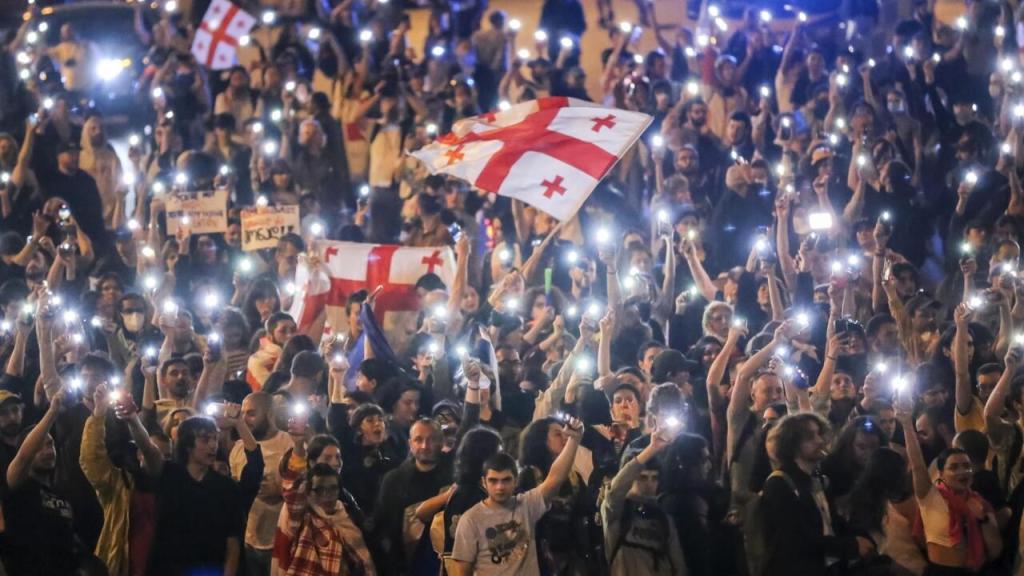
    The streets of Tbilisi have erupted in protests—protests against a government that has turned its back on its people’s aspirations for democracy and European integration.

    The images are both inspiring and heartbreaking: tens of thousands marching with EU and Georgian flags, their voices demanding a future of transparency and freedom, met with tear gas, water cannons, and violence.

    This is a pivotal moment—not just for Georgia, but for Europe.

    The decision by the Georgian Dream government to suspend EU accession talks is more than a policy choice; it’s a betrayal. It’s a betrayal of the Georgian people, who have consistently and courageously expressed their desire for a European future. And it’s a betrayal of the democratic values that form the bedrock of Europe.

    How did we get here?

    The ruling Georgian Dream party, accused of rigging last month’s parliamentary elections, has steadily moved the country away from its democratic commitments.

    The EU granted Georgia candidate status last year, but with clear conditions for reform. Instead of meeting those conditions, the government has doubled down on authoritarian tactics, passing repressive laws and silencing dissent.

    When the European Parliament called for accountability, Prime Minister Irakli Kobakhidze lashed out, accusing EU leaders of blackmail and foreign interference. His rhetoric, echoing that of other authoritarian-leaning leaders, seeks to distract from the undeniable: his government has failed to uphold the democratic promise Georgians fought so hard for.

    Now, Europe faces a choice.

    Will we act decisively to support the Georgian people in their quest for a democratic future? Or will we allow yet another government to undermine democracy while claiming impunity?

    The stakes are immense.

    Georgia is a nation that has consistently resisted Russian influence, standing as a beacon of pro-European sentiment in a region fraught with instability. Its people have made their choice clear, but their government has chosen to suppress that choice.

    We should not let this moment pass.

    The EU must act—not just with statements but with concrete measures. This means applying targeted sanctions against those responsible for democratic backsliding. It means bolstering civil society and independent media in Georgia. And it means making it clear that the door to Europe remains open—but only if the Georgian government respects its people’s will.

    Europe must stand with them—not just because Georgia’s future is at stake, but because Europe’s credibility is as well. If we fail to support those fighting for democracy on our borders, what message does that send to others looking to the EU as a model of freedom and justice?

    This isn’t just about sanctions or diplomatic pressure. It’s about reaffirming what Europe stands for.

    The Georgian people are showing us what courage looks like. Now it’s our turn to show them what solidarity looks like.

    This is a moment for leadership, for bold action, for standing on the side of those who fight for democracy.

    Let’s make it clear: Europe sees Georgia. Europe stands with Georgia.

    And together, we can ensure that the dream of a democratic, European Georgia does not die in the streets of Tbilisi.

    My friend Vato, is on the ground in Tbilisi, and is sharing firsthand accounts of the protests. His videos capture both the courage of the demonstrators and the stark reality of the violence they face—tear gas, water cannons, and masked enforcers intent on silencing dissent.

  • Unified Action Needed in Ukraine, Gaza. Global Security at Risk.

    Unified Action Needed in Ukraine, Gaza. Global Security at Risk.

    The intersections of military support, human rights, and diplomatic strategies are more intricate and critical than ever. We are witness to escalating crises across various conflict zones—from Ukraine and Gaza to South Sudan— and it becomes increasingly evident that our collective response must be both robust and nuanced. Addressing these challenges effectively requires a deep understanding of their complexities and a commitment to coordinated international action.

    The conflict in Ukraine has evolved into a focal point of European and global security dynamics. We know the aggression faced by Ukraine is not just a regional issue but a direct challenge to the principles underpinning international order. The stability of Europe hinges on Ukraine’s ability to resist and counter this war of aggression. Continued military support for Ukraine is not just an act of solidarity; it is a strategic imperative for maintaining European security. Germany’s decision to halve support is one that finds me in absolute disagreement.

    Ukraine’s outcome will significantly influence the future security landscape of Europe. Our support should continue to send a clear message about the commitment to upholding the sovereignty of nations and resisting any attempts to redraw borders through force in the 21st century. The European Union and NATO must continue to work together to ensure Ukraine remains resilient in the face of aggression, as this will directly impact the stability and security of the European continent.

    Human rights in conflict zones remain an area of profound concern. Whether in Ukraine, Gaza, or South Sudan, the fundamental rights of civilians must be preserved, even amidst the chaos of war. The protection of non-combatants and adherence to international humanitarian law are not merely theoretical principles but practical necessities for ensuring human dignity and mitigating the suffering of those caught in conflict. Our failure there speaks volumes.

    In Ukraine, reports of civilian casualties and infrastructure destruction underscore the urgent need for humanitarian corridors and aid. In Gaza, the dire conditions faced by civilians highlight the importance of ensuring that humanitarian needs are met while pursuing peace. Similarly, in South Sudan, where ongoing violence exacerbates the humanitarian crisis, international organizations must be empowered to provide relief and advocate for the protection of vulnerable populations.

    The international community must reinforce its commitment to human rights by ensuring that humanitarian principles guide military and political strategies. This includes supporting organizations that deliver aid, advocating for ceasefires to facilitate humanitarian access, and holding accountable those who violate human rights laws. The preservation of human rights amidst conflict is not optional but a fundamental aspect of our shared humanity.

    The conflict between Israel and Gaza has long been a subject of intense scrutiny, and recent developments have only intensified the need for strategic engagement. The situation in Gaza presents a clear challenge, in balancing security concerns with humanitarian imperatives.

    As I continue to follow these developments closely, it is clear that any resolution must address both immediate and long-term issues. The humanitarian impact on Gaza’s population is severe (not including the devastating death toll), and efforts to alleviate this suffering must be part of a broader strategy that includes achieving sustainable peace. This requires not only addressing current hostilities but also laying the groundwork for a lasting resolution that ensures security for Israel and justice for the Palestinian people.

    In the context of the ongoing conflict, it is more important than ever for NATO, the European Union, and the United States to work closely with Israel. This collaboration should focus on achieving Israel’s legitimate security objectives while also facilitating a resolution that addresses the humanitarian crisis in Gaza and ends the current bombing campaign.

    A comprehensive approach should include efforts to secure the safe return of hostages and to negotiate a ceasefire that halts the destruction in Gaza. This strategy must be part of a broader peace initiative that seeks to address the underlying issues of the conflict. The goal should be to achieve a balanced and sustainable resolution that ensures Israel’s security while addressing the needs and aspirations of the Palestinian people.

    The consensus among experts is clear: Israel’s long-term safety and stability are inextricably linked to the establishment of an independent and viable Palestinian state. The two-state solution remains the most feasible path to achieving a lasting peace. This solution envisions a sovereign Palestinian state coexisting peacefully alongside Israel, with both nations recognized and secure within internationally accepted borders.

    Supporting Israel’s security involves more than just addressing immediate threats; it requires a commitment to the principles of justice and self-determination for the Palestinian people. Working toward a two-state solution is not merely a diplomatic goal but a necessary component of ensuring a stable and secure future for both Israelis and Palestinians.

    We must of course be careful in understanding the context and the multitude of players involved in the Israeli-Palestinian conflict. The situation is shaped by a complex web of influences, including not only Hamas and its impact in Gaza but also regional actors like Iran and Hezbollah. These groups, along with various proxies and third-party interests, all play significant roles in the dynamics of the conflict, and are actively participating. In fact the real possibility of a Lebanon-Israel war, once again is incredibly worrying. Recognizing and addressing these diverse influences is essential for developing a well-rounded approach to achieving peace and security, as it ensures that the strategies we implement are informed by the full spectrum of regional and international interests.

    It is imperative that the international community, through unified and informed action, addresses these issues with both urgency and empathy. Our collective efforts will not only shape the future of the regions directly affected but also set a precedent for how global challenges can be met with solidarity and strategic vision.

  • Who wants to lead?

    Who wants to lead?

    Hello,

    The elections are over.

    But those of us who are engaged in politics know that elections are never over.

    That democracy is not a periodic appointment, but a constant, passionate, selfless and demanding engagement. Because democracy is simply the electoral system that allows participatory selection of leadership, but leadership is required throughout.

    I will continue to do my best, to contribute to our young country’s and our Union’s present and future, and to offer you reasons to participate and get engaged yourselves. My engagement did not begin a month ago, and will certainly not seize now.

    I’m grateful and thankful to all those who supported our effort, and I’m convinced that with your engagement, our generation will finally be able to take its future in its own hands.

    State of Affairs, Technology and Misinformation

    The situation in Europe worries me, and should worry us all. Whilst we enjoy some of the highest standards of living in the world, we have become complacent and susceptible to those who seek to divide us, and exploit our weaknesses.

    The extremes are polarising us, by amplifying our fears and using each other to drive us further apart. The moderate political centre, from socialists to conservatives, is being pulled further and further apart. Moderation, consensus, policies by and for all, are out — those who shout louder want increasingly, entirely different things.

    This is happening across Europe and across most Western liberal democracies. It’s not the first time our societies reach such a breaking point, however I still hope this time around we’ll be able to handle these situations more efficiently. After all, we’ve never had as much technology, never had the power to communicate as instantly, and never been as enabled to be informed and rally against a common cause (and unfortunately, empowered by the same technology to be misinformed and divided).

    Western leadership is dwindling, and that worries me for the world’s stability. Just look at who’s in Borgo Egnazia for the G7 today. Those who are dividing us internally, those politicians and the politics of division and finger pointing, those who claim to want to sustain every part of the system that supports us, whilst breaking and changing every part of it: they simply can’t. You can’t have your cake and eat it. Only moderates get that. And we’ve done a terrible job of communicating this.

    The Lack of Meaningful Debate

    Which brings me back to our elections. Where was the debate? Personally, if it weren’t for my own social media and online presence, which I maintained alone, I would have reached zero people. Unfortunately, I had zero media engagements. But even those who did. Was there debate? Was there real discussion about the big issues facing our continent today? Were there actual debates? I’d argue I only saw shows, but no debate. Talking points being communicated, but no exchange. And I refuse to believe that our public does not desire it. We saw very limited exchanges, heavily moderated exchanges. 

    Did we discuss the urgent questions surrounding our environmental impact on the world? Did we discuss any of the crucial debates happening worldwide around our access to resources? Specifically, plans to continue to press on with deep sea mining? Did we discuss the scopes and limitations of the European Union vis a vis our engagement and influence in Israel and Gaza, in Ukraine, in Russia, in China and Taiwan, in Africa? Did we discuss immigration beyond the talking points presented by political parties (with facts and expertise?); did we discuss the resurgence of religious political influence throughout Europe? Did we discuss voting participation in Luxembourg, and what it means that so many of our EU compatriots chose to vote in Luxembourg? And how about showing an interest in all candidates? Political parties do not define us, nor do they define our ideas; it is we, the party members, who define our parties — and by not allowing all of us some minimum visibility, you are not accurately representing either the process, ourselves, or the public’s options. I was asked not to criticise the press during the campaign, but I hope this is seen at least now, not as negative criticism, but positive feedback and criticism to improve. Because we desperately need the press today, we desperately need the media to contribute to our democracy.

    “My advice to the press is to remember that you’re an important part of government and democracy, and act like it.” Howard Dean, former governor of Vermont

    “The backbone of any democracy is an independent, professional and responsible media. Their role is to inform, criticise and stimulate debate.” Peter Joseph Millett CMG, British Diplomat

    “The media today is driven by numbers. If you get a congressman idiotic enough to take pictures of himself and tweet them out, that gets 600 times more coverage than the dangers of an Iranian nuclear weapon.” Newt Gingrich, former speaker of the House (USA)

    If we want to restore our ability to decide together, based evidence and not ideology, if we want to enable ourselves to live and co-exist and decide together, we need to enable an environment that rewards stepping up to offer yourself for leadership, an environment where ideas and exchange of facts and perspectives is not only permitted, certainly not thwarted, but supported. We need the press to step up, and play a role in mediating and flourishing our democratic debate, or it will be entirely ignored, for the much more efficient, direct, and entire uncensored social media, where extremist, flashy, unfounded claims attract, maintain, and grow the voting base of those who offer very little substance, but a very good show.

    The world needs leadership, Europe needs leadership, Luxembourg needs leadership — and we need my generation, your generation, the generation after us, to be inspired and convinced, that the herculean task of putting yourself up for public leadership positions, is worthwhile and not simply toxic and thankless (even if it’s certainly the latter).

    (By the way, if some of you are thinking of our climate and ability to protect our natural habitat while reading this, well done! Without clear leadership, we will be en route to destroy the very ecosystem that sustains all of us)

    I sincerely hope that over the next 5 years, I can convince more of you to get involved, and get engaged in our shared decision making.

    Who wants to lead?

    The fight for our democracies must continue, with you.

    We’re just beginning.

    Christos FLOROS

    My ancestors called themselves Roman. I call myself European. How long will we last? It’s up to us.

  • Every Nation for Itself

    Every Nation for Itself

    This is not just a ‘thank you’ post.

    But first, yes:

    28,874 personal thank you‘s for supporting me.

    And 253,344 thank you‘s for supporting our incredible DP – Demokratesch Partei team.

    To have earned your trust, your support, your faith, in my, and our team’s ability to deliver for you, that requires a huge, and sincere, thank you.

    My projections for Luxembourg and Europe were unfortunately accurate, and yet on an emotional level, we always hope to do better.

    One always hopes to do better than their own data indicates. Even if, again, I have to thank you, for giving me almost double the personal support I expected in my first election, especially one that I fought without any press, or media coverage — entirely with you, entirely grassroots. But this is not about any one person, or even any one country. Because these were European elections, about the future of our Union.

    So, let’s make it clear:

    The extremes did not win these elections, but many of us around Europe lost them. By failing (over the years, not just in this campaign) to convince our fellow citizens, that we can do better. And we must listen very clearly to this democratic protest.

    The biggest loser of these Elections is the European Union.

    ‘Divide et impera’: we are being divided, and the fact that many of us seem to ignore a carefully curated plan being actioned, is incredibly worrying.

    Those who seek to divide us have infiltrated our society, our media, our industries, our public discourse, and our politics.

    And the trend is clear, our Union is polarised, both in terms of political direction and in terms of supranational unity.

    Those of us who are responsible, moderate, politicians must be willing to take responsibility for this loss of confidence in our Union.

    Those of us who have opened a history book more than twice in our lives, must be willing to continue working, just as passionately, just as determined, to ensure history does not repeat itself.

    We must be willing to continue doing everything we can, to ensure Europe delivers for its citizens.

    Because we have got to take responsibility for the results all over Europe.

    Even if my generation is only just entering politics, we must be willing to take responsibility for the previous generations too. Because that’s what leaders do.

    European citizens are tired of overregulation. European citizens are fed-up with a European Union unable to work successfully together on border control. European citizens are frustrated, that we keep asking more of them, than we are able to offer them. European citizens are tired of handouts, when the majority of them work incredibly hard for their dues. European citizens want to be empowered to succeed.

    In the process of this protest, in the process of this polarisation, we are having our Trump moment. Mirroring what is happening in the United States, as I told Christelle BRUCKER yesterday. The big difference however is this: Trump loves Trump. And in Europe we don’t actually elect a single Trump. We elect multiple different Trumps, who each only love themselves, and their nations. A Europe of nations, working in their own self-interest, in a G-Zero world (yes, I’ve stolen the title from Ian Bremmer‘s 2012 book) will not deliver for any European citizen, regardless of how industrious, capable or ambitious the individual nation may be.

    Our countries, may have bright histories, but only together, do we pull enough weight in the world today (and even together, we’ve been reducing our weight enormously over the years – see image below). The United States are innovating, and we are simply falling behind, as China rises at an incredible pace.

    Only a strong, empowered, and purpose-led European Union can deliver for European citizens. Whether Spanish, French, Greek or Luxembourgish. Whether Romanian, Portuguese, German or Finnish.

    Share of World GDP / observations in text above

    So bottom line, here’s what I am going to do.

    • I will continue to be incredibly active in my country’s politics, at every level, micro-local, local, national and international.
    • I will continue investing my time and energy for you, within the DP – Demokratesch Partei to ensure we can conserve our Union and ensure we collectively succeed in the new global order.
    • I will continue attempting to make our politics more accessible, and more open to both criticism and participation.
    • I will continue encouraging, with my incredible colleague Jana Degrott (who by the way, not only had an incredible score, but also proved to be one of our country’s most committed politicians) more people to get involved.
    • I will continue speaking about AI, Defence and Cybersecurity (including Misinformation and Foreign Influence).
    • I will continue speaking about Europe’s competitiveness, our economy, our industries.
    • I will continue to ask for increased availability of information across our media in Luxembourg.

    And you may have guessed it:

    I will continue asking more of you, to choose to take responsibility and REGISTER TO VOTE.

    I want to thank all of you again for your support,

    Thank Charles Goerens , Amela Skenderovic , Nancy Braun , Jana Degrott , Gusty Graas and the entire team, every section, every MP, every member, every volunteer, for their support, and engagement into our campaign, to strengthen Europe.

    I want to also thank you for reading,

    I believe in Europe.

    If every nation in our Union plays for itself, we will all lose in the new state of the world.

    If we can continue to play together, with real, purposeful leadership, then we can succeed.

    Thank you for everything,

    This was the hardest thing I’ve ever done, and I look forward to doing it again for you, for our city, our country, our Union, and yes, the collective success of our world.

    Kind regards,

    Christos FLOROS