The era of rules-based international order is over — and we should embrace our fate.
The world’s richest democracy is making it very clear: sovereignty is negotiable, alliances are optional, and the only thing that really matters is what one man feels on any given day.
After all, who needs boring, outdated concepts like international law, multilateral cooperation, or predictable foreign policy when we can simply crown Trump the rightful king of the free world and let him run global affairs the way he’s always wanted — by gut instinct, grievance, and a gold-plated iPhone while he chats with his Gold Card friends?
If he wants Canada, he can have it.
If Europe wants to stay independent, it should probably learn how to build tanks. And if Ukraine still hopes for support, they should definitely start investigating Hunter Biden and sign away their natural wealth.
That’s the deal — take it or leave it.
Obviously, absolutely not.
This isn’t a joke, though the absurdity of it is hard to ignore.
What’s happening right now is more than just the return of Trump—it’s the systematic dismantling of the world order built since 1945. Ukraine’s future hangs in the balance of every Western election. The Middle East simmers on the edge of full-scale regional war.
Meanwhile, the U.S. is flirting with imperial fantasies — making it very clear that this administration won’t just turn away from its allies, but actively reshape the world into one where might makes right.
What’s left of Europe’s complacency should have been shattered by now.
That means investing in our own defense. It means building our own digital infrastructure. It means competing in technology, media, and the very systems that shape the public sphere — without waiting for permission or protection.
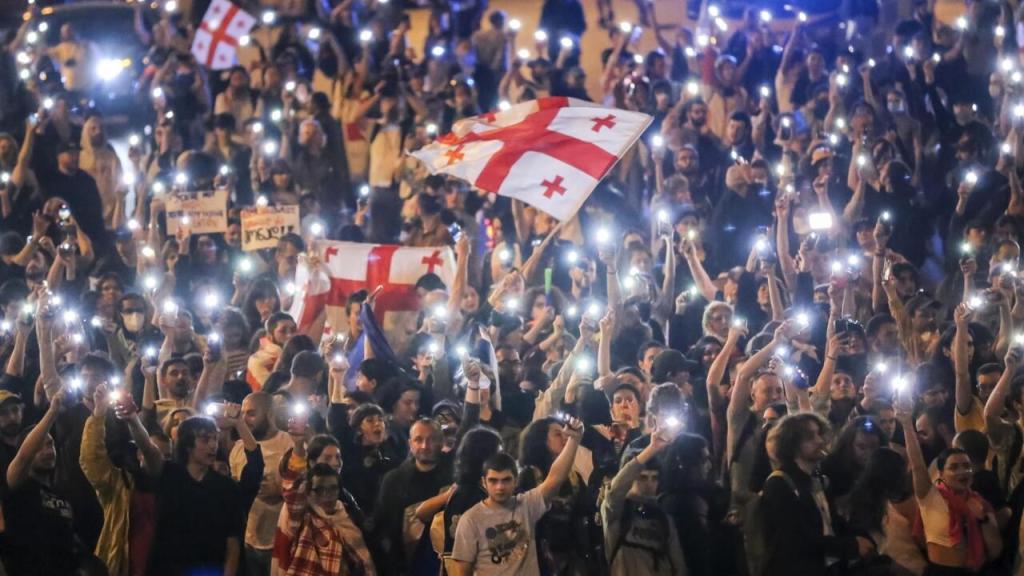
The streets of Tbilisi have erupted in protests—protests against a government that has turned its back on its people’s aspirations for democracy and European integration.
The images are both inspiring and heartbreaking: tens of thousands marching with EU and Georgian flags, their voices demanding a future of transparency and freedom, met with tear gas, water cannons, and violence.
This is a pivotal moment—not just for Georgia, but for Europe.
The decision by the Georgian Dream government to suspend EU accession talks is more than a policy choice; it’s a betrayal. It’s a betrayal of the Georgian people, who have consistently and courageously expressed their desire for a European future. And it’s a betrayal of the democratic values that form the bedrock of Europe.
How did we get here?
The ruling Georgian Dream party, accused of rigging last month’s parliamentary elections, has steadily moved the country away from its democratic commitments.
The EU granted Georgia candidate status last year, but with clear conditions for reform. Instead of meeting those conditions, the government has doubled down on authoritarian tactics, passing repressive laws and silencing dissent.
When the European Parliament called for accountability, Prime Minister Irakli Kobakhidze lashed out, accusing EU leaders of blackmail and foreign interference. His rhetoric, echoing that of other authoritarian-leaning leaders, seeks to distract from the undeniable: his government has failed to uphold the democratic promise Georgians fought so hard for.
Now, Europe faces a choice.
Will we act decisively to support the Georgian people in their quest for a democratic future? Or will we allow yet another government to undermine democracy while claiming impunity?
The stakes are immense.
Georgia is a nation that has consistently resisted Russian influence, standing as a beacon of pro-European sentiment in a region fraught with instability. Its people have made their choice clear, but their government has chosen to suppress that choice.
We should not let this moment pass.
The EU must act—not just with statements but with concrete measures. This means applying targeted sanctions against those responsible for democratic backsliding. It means bolstering civil society and independent media in Georgia. And it means making it clear that the door to Europe remains open—but only if the Georgian government respects its people’s will.
Europe must stand with them—not just because Georgia’s future is at stake, but because Europe’s credibility is as well. If we fail to support those fighting for democracy on our borders, what message does that send to others looking to the EU as a model of freedom and justice?
This isn’t just about sanctions or diplomatic pressure. It’s about reaffirming what Europe stands for.
The Georgian people are showing us what courage looks like. Now it’s our turn to show them what solidarity looks like.
This is a moment for leadership, for bold action, for standing on the side of those who fight for democracy.
Let’s make it clear: Europe sees Georgia. Europe stands with Georgia.
And together, we can ensure that the dream of a democratic, European Georgia does not die in the streets of Tbilisi.
My friend Vato, is on the ground in Tbilisi, and is sharing firsthand accounts of the protests. His videos capture both the courage of the demonstrators and the stark reality of the violence they face—tear gas, water cannons, and masked enforcers intent on silencing dissent.
To have earned your trust, your support, your faith, in my, and our team’s ability to deliver for you, that requires a huge, and sincere, thank you.
My projections for Luxembourg and Europe were unfortunately accurate, and yet on an emotional level, we always hope to do better.
One always hopes to do better than their own data indicates. Even if, again, I have to thank you, for giving me almost double the personal support I expected in my first election, especially one that I fought without any press, or media coverage — entirely with you, entirely grassroots. But this is not about any one person, or even any one country. Because these were European elections, about the future of our Union.
So, let’s make it clear:
The extremes did not win these elections, but many of us around Europe lost them. By failing (over the years, not just in this campaign) to convince our fellow citizens, that we can do better. And we must listen very clearly to this democratic protest.
The biggest loser of these Elections is the European Union.
‘Divide et impera’: we are being divided, and the fact that many of us seem to ignore a carefully curated plan being actioned, is incredibly worrying.
Those who seek to divide us have infiltrated our society, our media, our industries, our public discourse, and our politics.
And the trend is clear, our Union is polarised, both in terms of political direction and in terms of supranational unity.
Those of us who are responsible, moderate, politicians must be willing to take responsibility for this loss of confidence in our Union.
We must be willing to continue doing everything we can, to ensure Europe delivers for its citizens.
Because we have got to take responsibility for the results all over Europe.
Even if my generation is only just entering politics, we must be willing to take responsibility for the previous generations too. Because that’s what leaders do.
European citizens are tired of overregulation. European citizens are fed-up with a European Union unable to work successfully together on border control. European citizens are frustrated, that we keep asking more of them, than we are able to offer them. European citizens are tired of handouts, when the majority of them work incredibly hard for their dues. European citizens want to be empowered to succeed.
In the process of this protest, in the process of this polarisation, we are having our Trump moment. Mirroring what is happening in the United States, as I told Christelle BRUCKER yesterday. The big difference however is this: Trump loves Trump. And in Europe we don’t actually elect a single Trump. We elect multiple different Trumps, who each only love themselves, and their nations. A Europe of nations, working in their own self-interest, in a G-Zero world (yes, I’ve stolen the title from Ian Bremmer‘s 2012 book) will not deliver for any European citizen, regardless of how industrious, capable or ambitious the individual nation may be.
Our countries, may have bright histories, but only together, do we pull enough weight in the world today (and even together, we’ve been reducing our weight enormously over the years – see image below). The United States are innovating, and we are simply falling behind, as China rises at an incredible pace.
Only a strong, empowered, and purpose-led European Union can deliver for European citizens. Whether Spanish, French, Greek or Luxembourgish. Whether Romanian, Portuguese, German or Finnish.
Share of World GDP / observations in text above
So bottom line, here’s what I am going to do.
I will continue to be incredibly active in my country’s politics, at every level, micro-local, local, national and international.
I will continue investing my time and energy for you, within the DP – Demokratesch Partei to ensure we can conserve our Union and ensure we collectively succeed in the new global order.
I will continue attempting to make our politics more accessible, and more open to both criticism and participation.
I will continue encouraging, with my incredible colleague Jana Degrott (who by the way, not only had an incredible score, but also proved to be one of our country’s most committed politicians) more people to get involved.
I will continue speaking about AI, Defence and Cybersecurity (including Misinformation and Foreign Influence).
I will continue speaking about Europe’s competitiveness, our economy, our industries.
If every nation in our Union plays for itself, we will all lose in the new state of the world.
If we can continue to play together, with real, purposeful leadership, then we can succeed.
Thank you for everything,
This was the hardest thing I’ve ever done, and I look forward to doing it again for you, for our city, our country, our Union, and yes, the collective success of our world.
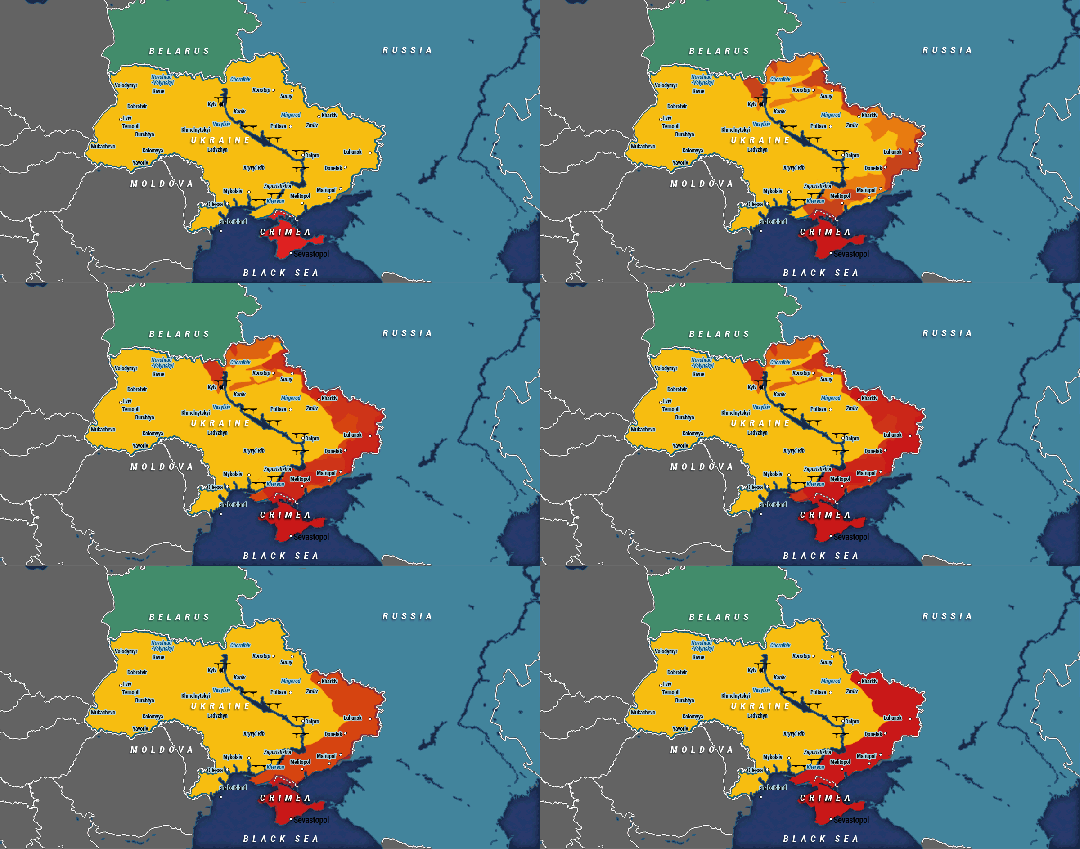
Recent advances by Russian forces north and north-east of Kharkiv and intensified attacks along the eastern front are reminders that we must remain steadfast in supporting Ukraine.
Russia’s recent territorial gains in Ukraine represent a significant threat to the stability and security of the European continent. The advances near Kharkiv and the intense fighting in the eastern regions highlight Moscow’s persistent ambition to extend its influence and control further into Europe. Allowing Russia to succeed would embolden other authoritarian regimes, undermine NATO’s collective security framework, and destabilize the broader region.
The war in Ukraine is not just a regional conflict; it is a fundamental battle over the principles of national sovereignty and the rule of law.
While other urgent and brutal conflicts and warfare around the world understandably capture public attention, we must not lose sight of the ongoing situation in Ukraine. Despite heavy losses, Ukrainian forces continue to hold critical positions, demonstrating the importance of sustained support.
By supporting Ukraine, we defend the principles that underpin our global order and ensure that aggression and lawlessness do not prevail.
The world must not turn away. It is imperative that we maintain our support and stand united against the forces of tyranny and oppression (wherever they are).
At the same time, while we grapple with the grave allegations against Israel and the complex situation in Gaza, it is crucial to prioritise human lives first. Yes, of course, the international community must strive to support the Palestinian peoples’ self-determination and ensure that any violations of international law are met with consequences. However, our immediate priority must be the cessation of all warfare to prevent further loss of life.
The tragic situations in Ukraine, Gaza, and other conflict zones demand urgent attention and resolution. Ending the bloodshed must come first, paving the way for peace and justice to follow.
Soundbites dominate discourse. National interests overshadow broader visions. We lose sight of the bigger picture. This is even more apparent in these European Parliament elections, where the ballot box may once again become a battleground for national grievances and triumphs rather than a platform for discussing and deciding the future of Europe as a whole.
So, is it really Europe we’re talking about?
In a European post-2004 era marked by unprecedented interconnectedness, where events in one corner of Europe and the globe can ripple across continents in seconds, the answer should be, a resounding yes. Whether it’s climate change, migration, or economic instability, the challenges facing Europe today transcend national borders. Ignoring this reality in favor of narrow, short-term interests is not only shortsighted but also perilous. Fragmented approaches, driven by individual national interests, will only serve to weaken our collective resilience. To confront the next stage of the global order effectively, we need a strong, cohesive EU capable of speaking with one voice on the world stage.
It’s time to talk about Europe.
This means recognizing that our fates are intertwined, and that only by working together can we navigate the challenges that lie ahead.
It’s also about reclaiming our agency in shaping the world around us.
We have a responsibility to engage in constructive dialogue, to seek common ground, and to advocate for policies that advance the greater good.
This is not to say that national interests should be disregarded. On the contrary, they should be viewed through a European lens, mindful of their implications for the continent as a whole. By aligning our priorities and pooling our resources, we can amplify our impact and create a Europe that is not only stronger but also more resilient and prosperous.
Are we willing to rise to the challenge of building a better Europe for future generations?
The time for complacency is over. The time to talk about Europe is now.



 Christos Floros